Replying to Google reviews: examples for praise and criticism
Reading time: about 5 minutes for the main text. Use templates and details as needed.
Full version with templates, calculations and further checks
A short thank you suits a positive review. When someone raises a concern, your business first needs to establish what happened. If a mistake is confirmed, you can apologise for it. If the events are still unclear, take the feedback seriously and offer direct contact without accepting the allegation as fact. Google recommends looking into negative experiences and being honest about your own mistakes. [1]
Replies to reviews, which Google calls ‘Rezensionen’ in German, are public. Personal details therefore belong in a direct conversation. Decide whether to report a review for a possible rule breach separately from replying and handling the complaint. [1] [2]
Choosing a reply that fits the review
Read the review text first. Stars alone do not explain what happened. An enquiry or consultation can also prompt feedback, even if it did not lead to a job. This is one possible situation, not proof of a particular interaction. [a] Google’s rules require actual experiences with the business. [3]
This practical guide shows what you can base your reply on. [b]
| Starting point | Suitable public response |
|---|---|
| Positive, with no text | A short thank you without invented project details |
| Specific praise | Refer to the point the reviewer actually mentioned |
| Mistake confirmed internally | Name the mistake and apologise for it |
| Criticism still unresolved | Acknowledge the concern and offer direct contact |
| Interaction unknown | Explain the uncertainty without accusing the reviewer of deception |
For a positive review with no comment, you can use this fictional template: [a]
Thank you for your positive review and for taking the time to leave it. We appreciate your feedback.
If someone specifically praises the cleanliness during a bathroom renovation, you can refer to that. Mixed feedback needs a reply to the criticism too. An unfamiliar profile name alone does not prove that a review is fake. For these situations, see all seven fictional reply templates and the conditions for using them. [a]
If the review specifically praises the coordination and cleanliness during the bathroom renovation, you can use this fictional template. It refers to those points: [a]
Thank you for your detailed feedback. We are pleased that you appreciated the coordination and cleanliness during the bathroom renovation. We will gladly pass your praise on to our team.
Use the last sentence if you will actually pass the praise on. A thank you does not need extra details about the scope of the work. It should not include an outcome the reviewer did not describe either. [a]
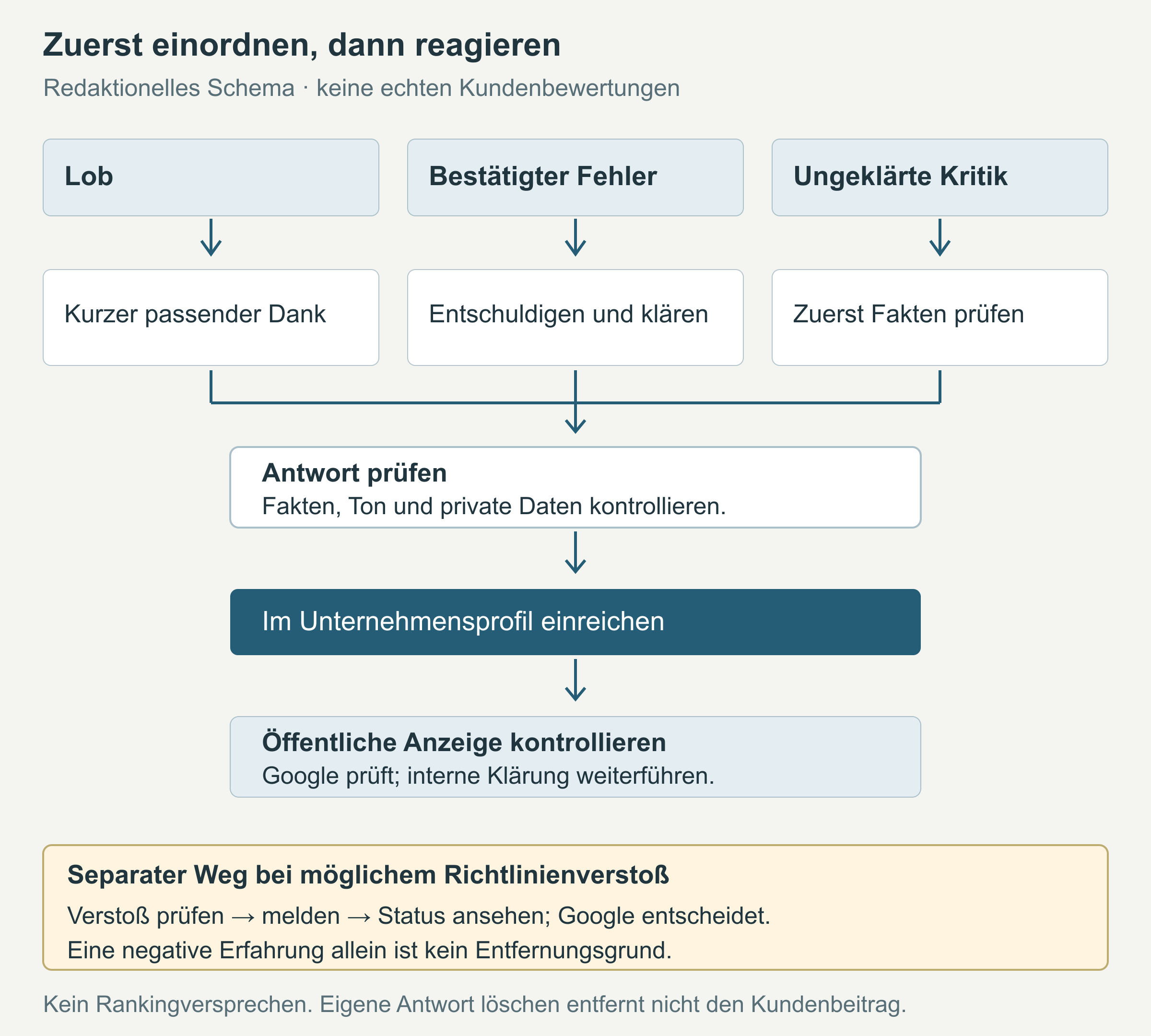
Example: an agreed callback did not happen
In the following fictional case, the business has checked and confirmed that the agreed callback did not happen on time. Only with that knowledge is this clear apology appropriate. The text is not taken from a real customer conversation: [a]
Thank you for your feedback. We did not call you back on time, even though we had agreed to do so. We apologise for this. We would like to discuss your concern with you directly. Please get in touch using the contact details in our Google profile.
The reply names the confirmed mistake. It does not promise a remedy or an appointment that no one has yet agreed to. If the business already has a suitable private way to contact the person, it can arrange the callback itself and adjust the request to get in touch accordingly. Someone needs to take responsibility for this. [a]
If the allegation is still unresolved, this template would be too definite. In that case, use the reply for unresolved criticism, which takes the reported problems seriously and offers a conversation. Copying a text without checking it could otherwise admit a mistake that your business has not yet established. [a]
For a complaint that is still unresolved, the full fictional template reads: [a]
Thank you for your feedback. We take the problems you describe seriously. We would like to discuss the outstanding points with you directly. Please get in touch using the contact details in our Google profile. We will discuss the details of your concern with you in private.
This wording leaves open how the events should be assessed. Publicly setting out counterclaims or speculating about the person’s motives will not help with that assessment. A technical diagnosis also needs the known facts and sequence of events first. [a]
If, after checking, you still cannot confidently match the review to an enquiry or job, the starting point is different. This full fictional template explains that you have not been able to make the connection: [a]
Thank you for your feedback. From the publicly visible information, we cannot currently identify with confidence which interaction with our business you are referring to. We would like to look into your concern. Please get in touch directly using the contact details in our Google profile.
The person may use a different name, or there may have been a mix-up. Saying ‘You were never a customer’ would claim a level of certainty that your checks have not established. [a]
Keep customer data private and take responsibility for resolving the issue
For problems, Google recommends direct contact by phone or email and advises against sharing private data. [1] Use this working rule when drafting a reply: leave out customer or site addresses, job reference numbers and invoice details. The same applies to notes from conversations and personal circumstances. Even if the review includes such information, you do not need to repeat or confirm it. [b]
Personal data can also make someone identifiable indirectly; Article 4 of the GDPR covers both forms of identification. [4] A reply can therefore leave out a greeting by name. Under this working rule, photos of a private project or information about relatives are also unsuitable as public evidence. You can acknowledge the concern factually without reconstructing the job for other readers. [b]
When you ask someone to get in touch, they must be able to reach a person who can look into the issue. Decide who will respond and who is authorised to agree a solution. If the profile’s contact details are out of date, use the checklist for your existing Business Profile. [b]
For a missed callback, your business should be clear about who will make the next contact. That person needs the history and the points still outstanding. A general request in the public reply is not enough if the later message gets lost between the office and the site. [b]
In a private conversation, the information needed to identify and handle the case is enough. This follows the principle of data minimisation in Article 5 of the GDPR. [4] Under this working rule, a justified remedy should not depend on a change to the review; Google prohibits incentives to revise or remove negative reviews. [3]
Check the text and submit it through your Google profile
Before submitting the draft, read it from an outsider’s perspective. It should be clear without disclosing private evidence. Check the following: [b]
- Every statement about a mistake or an action already taken has been confirmed within the business.
- The reply addresses the review and contains no advertising.
- Promises have been agreed internally, and the contact method offered works.
For an emotional complaint, a second authorised person can read the draft. They can check that the tone stays calm and that the statements fit the known events. Short templates need this attention too: copying them means taking on every claim and promise they contain. [b]
To reply, you need a verified Business Profile and a Google Account with permission to manage it. Open ‘Read reviews’, select ‘Reply’ for the relevant review and enter the checked text. Select ‘Reply’ to submit it. Google checks the reply before publication. Once approved, it appears publicly beneath the review, and the reviewer is notified. [5]
Check later whether the saved text actually appears publicly. Submitting it alone does not confirm that it is visible. You can edit or delete your own reply. This does not remove the customer’s review. [5]
Report a possible rule breach separately
A negative review cannot automatically be removed. Respectfully described negative experiences are allowed. Spam or personal data shared without consent may breach Google’s content rules. [3] Not finding a matching job is not enough evidence on its own. [b]
With a low star rating and no comment, all you initially know is the rating. You can ask the reviewer to get in touch privately, without inventing a possible fault. The person does not need to supply a job reference number publicly. If they do not take up the offer to talk, that still does not establish a policy breach. [a]
If you would like to reply, you can use this full fictional template: [a]
We are sorry to see your negative rating. Your review has no comment, so we do not yet know what we could improve. If you would like to tell us about your concern, you can reach us using the contact details in our Google profile.
If you have a specific reason to suspect a breach, open ‘Read reviews’ in the profile and select ‘Report’ for the review. Choose the reason and submit the report. You can track its status in the Reviews Management Tool. If Google finds no breach, a one-time appeal is available. The detailed guide to reporting a review explains the process. [2]
Google decides on the report and does not mediate disputes between businesses and customers. Removal is not guaranteed. Someone in the business therefore still needs to take responsibility for the complaint, even if you also report a rule breach. [2] [b]
Editorial version dated 16 October 2026. Numbers lead to sources; letters explain editorial examples or recommendations. Each source note states what the source supports.
[a] Editorial examples. Content labelled as a template or fictional illustrates possible situations. These are not real customer cases or evidence of a measured effect.
[b] Practical recommendations. The suggested processes and decision aids are editorial applications of the cited guidance. Their specific effect on enquiries or jobs has not been measured here.
[c] Editorial illustration. The illustration shows how things relate to one another. It is neither a real customer reference nor evidence of a measured effect.
Sources and context (5 sources)
- Tips for getting more reviews: Tips for writing better replies to reviews — Google
Google recommends short, relevant, polite replies, no sales copy, looking into negative experiences, being honest about mistakes and offering direct contact without disclosing private data. These are recommendations for action; the seven fictional templates and the conditions for using them in your business do not come from Google and are not tested recipes for success. Checked: 2026-10-16.
- Report inappropriate reviews on your Business Profile — Google
Describes reporting a breach of the content policy, checking the status and making a one-time appeal. Reporting alone does not guarantee removal; this is not a full legal assessment of all possible grounds for requesting deletion. According to its help page, Google does not mediate disputes between businesses and customers. Checked: 2026-10-16.
- Prohibited and restricted content — Google Maps
Covers the requirement for actual experiences, the ban on incentives to change or remove negative reviews, protection of personal data, permitted business contact details, and the rules on certain threats and respectfully described negative experiences. Google’s definitions and exceptions are platform rules, not a full interpretation of the GDPR. An unfamiliar profile name or lack of a response does not prove a breach; this is an editorial conclusion intended to support careful application of the rules. Checked: 2026-10-16.
- Regulation (EU) 2016/679: Articles 4 and 5 — European Union / EUR-Lex
Used only for the definition of personal data (Article 4(1)) and the principle of data minimisation (Article 5(1)(c)). Does not state that consent is the only legal basis for every publication; does not assess a specific customer dispute or entitlement to remedial work. The readable Official Journal version was opened. A further direct attempt to open the consolidated CELEX version encountered a JavaScript/bot check; no claim is made to have read that version in full. Checked: 2026-10-16.
- Manage customer reviews — Google
Verified profile, steps for replying, checks before public display, notification, and editing or deleting your own reply. Does not establish any effect on rankings or revenue. The later visual check recommended in this article is an editorial check; no fixed approval time is promised. Checked: 2026-10-16.