Full version with all templates and detailed checks. Back to the main article
Winning customers for your trades business: a plan for regular enquiries
A new contact is of interest to your trades business when the project fits the work you take on. The location and available time need to fit too. A business offering complete bathroom renovations is looking for different jobs from a plumber who mainly carries out repairs. More advertising does not answer that question.
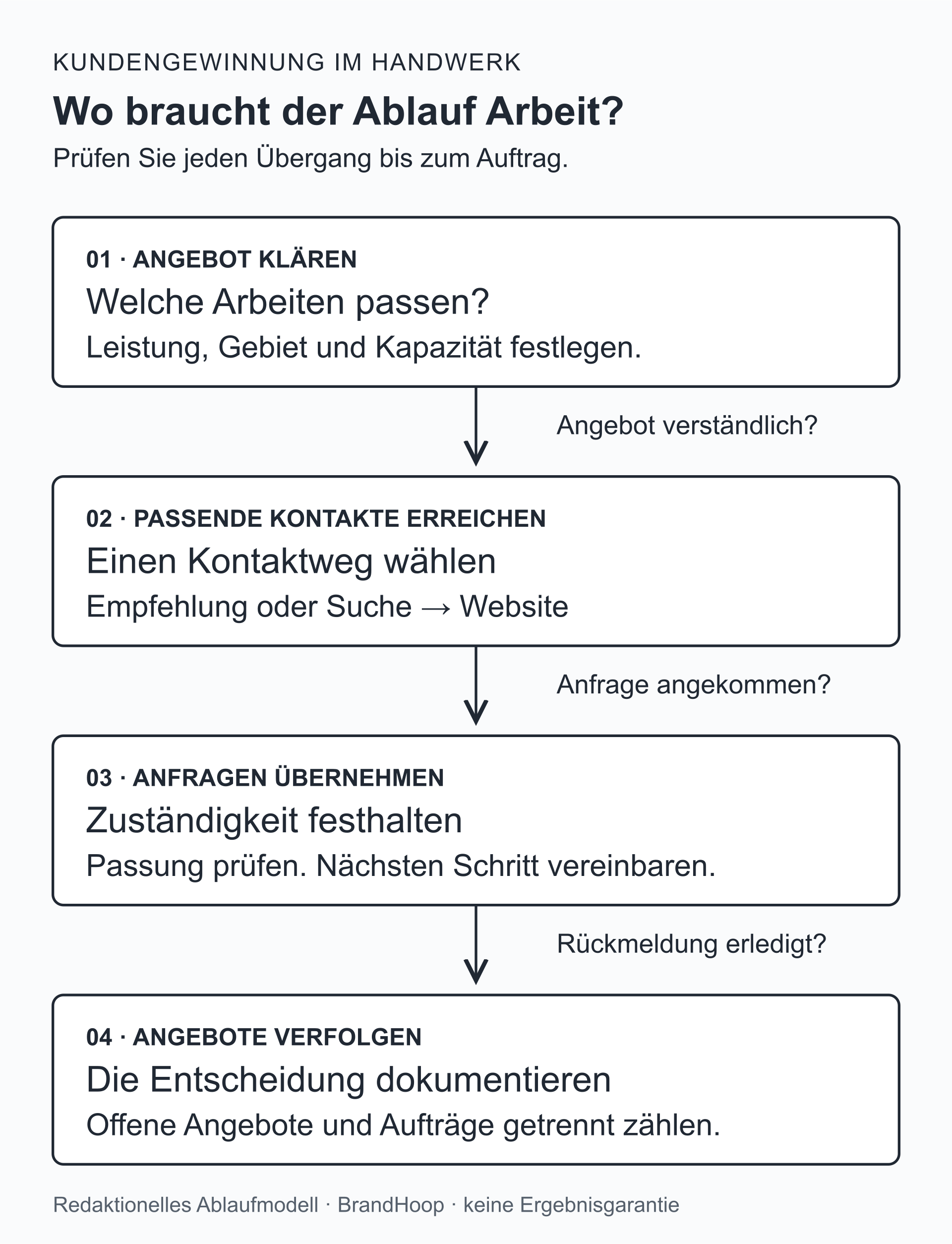
To win customers, it is worth looking at the whole path to a job. A prospective customer hears a recommendation, reads about your services on your website and gets in touch with the business. Their enquiry then needs a reply and a next step. Something may be missing at any point: visibility, a clear description of your services or simply time for a return call. [c]
If very few enquiries come in, start with visibility and marketing channels. If most projects are unsuitable, first clarify your services and service area. For suitable enquiries that go unanswered, handling them within the business is the next step. Bathroom renovation is used as an example; joiners, electricians and painters can apply the questions to their own services. [b]
Which jobs suit your business?
Start with your services and your calendar. Choose one or two services for which you are actually looking for new customers and still have capacity. Consider which work is worthwhile, as well as the area you cover. A project may be a good fit for your skills but still be too far away or fall in a period that is already booked. [b]
A short description helps people outside the business understand these limits. It states which work you take on, where you work and when you can accept new jobs. Include the details you need for an initial assessment. For a bathroom renovation, these might be the location, a description of the project and the preferred timeframe. Your actual working process determines which information is needed. [b]
One possible example is: “We carry out complete bathroom renovations within our stated service area. For an initial discussion, we need the location, a short description and your preferred timeframe.” This is a fictional wording example, not an offer from BrandHoop. Only include services and commitments in your text if your own business can fulfil them. [a]
How online marketing and sales work together
Online marketing makes your services visible and understandable on the internet. Here, sales means working with prospective customers: discussing the project, answering open questions and following up on a quote until a decision is made. Both are part of customer acquisition, which means winning new customers. In a small trades business, the same person may handle these tasks.
A professional presence can support your reputation. In the process described here, whether a contact becomes a job also depends on what happens after the enquiry. An unanswered message does not lead to a site visit. [b]
What happened to previous contacts therefore also matters when choosing a channel. An additional marketing channel needs someone within the business who can take responsibility for the new enquiries. [b]
Compare marketing channels
A channel is a route through which people hear about your business. Recommendations and the search for a tradesperson can work together: someone gets your name from an acquaintance, then checks your website to see which work you take on. [a]
For a small business, we recommend starting with a manageable combination of recommendations, a website and a Google Business Profile. The profile is the listing that shows your business information in Google Search and on Maps. [1] Once these basics are in place and enquiries reach the business, you can test another marketing channel with a clear purpose. Your own results will show which channel is worthwhile. [b]
The table compares five channels using the same questions. Alongside possible uses, it shows the preparation and figures you need for the comparison. [b]
| Channel | What you can use it for | What to prepare | What to review within the business |
|---|---|---|---|
| Recommendations and networking | Connect customers and partners with suitable prospective customers | A short service description, contact details that are easy to pass on and suitable partners | Suitable enquiries and, where known, the person or business that recommended you |
| Google Business Profile | Show your services and working area in local search | Appropriate category and services, your actual service area and current photos | Contacts you can trace to local search and the resulting enquiries |
| Website and SEO (search engine optimisation) | Explain your services before an enquiry and make them findable in search | Pages for your main services, information about your region, project examples and contact options | Suitable enquiries per service page and the quotes prepared as a result |
| Search ads | Test advertising for one service in one region | A suitable landing page, ads, a budget limit and someone responsible for enquiries | Costs and working time per suitable enquiry, along with jobs won |
| Social media | Show your own work on social platforms and make conversations possible | Project pictures cleared for use, clear explanations and contact information | Conversations and enquiries from posts; new jobs recorded separately from reactions to posts |
A project case study shows completed work that you have permission to share. One project can provide content for several channels: a description on the website, photos in the Business Profile or an explanation of a work step on social media. Adapt the text to its use. Google Maps has its own rules: photos taken inside private flats or houses do not belong there. [2] A short post needs a different opening from a detailed project page. [b]
Which channel suits your current workload
If very few new enquiries come in, you can start by working on your service pages and Business Profile. [b]
If enquiries are unsuitable, first ask what expectations your information creates. If, for example, it leaves out the limits of your service area or the scope of your services, you can make that explanation clearer. An additional channel would just spread the same unclear description further. [b]
Search ads need their own plan for the budget and landing page. Social media requires suitable content and time to manage it. Job platforms or tenders may also suit your business. Compare current fees, the work involved in preparing a quote and the types of projects offered. The specific conditions vary by provider or tender and must be checked there. [b]
Use suitable enquiries and jobs won in relation to the total work and cost involved as your common basis for comparison. This also makes it clear when a seemingly inexpensive contact takes a lot of time to discuss the work with and prepare a quote for. [b]
Recommendations and honest reviews
Word of mouth means people recommending your business to others. In your day-to-day work, you can help customers describe your services accurately and keep your contact details to hand. Clear agreements and answers to follow-up questions support this. In conversations with partners, you can also explain which projects they can approach you about. [b]
A recommendation establishes a contact. A Google review describes an experience publicly. Google requires a genuine experience and prohibits incentives such as discounts or gifts. Google also prohibits preventing negative reviews or selectively asking only for positive ones. [3]
A neutral process invites customers to give honest feedback without specifying the rating you want. Google permits these requests as long as you offer no incentives and do not influence the rating or content. [3] Avoid putting pressure on customers; you can respond calmly and factually to praise and criticism. The content policies describe the limits in more detail. [b]
Only use project descriptions, names and photos in case studies when the necessary publication rights and permissions are in place. This preparation comes before publication. [b]
Stay in touch with existing customers
Here, customer retention means staying in contact after a completed job. This can include agreed follow-ups and useful advice on caring for or using your work when the project is completed. Customers should also know how to reach your business for future projects. Only mention maintenance if you actually offer that service. [b]
Previous work together does not, however, give general permission for later advertising messages. § 174 TKG 2021 makes direct marketing by phone and electronic mail subject to specific conditions. [4] Keep an agreed message about an ongoing project separate from an additional advertising campaign in your planning. The section on direct marketing explains this boundary. [b]
Your website and local Google search
Explain your services on your website
Your website gives you room to describe a service in more detail. Someone who heard your name through a recommendation can also look up your business details there. The service page explains a particular type of work: what you take on, where you work and how the first discussion works. Similar projects and a clear way to get in touch fit here too. [b]
For a bathroom renovation, a project example can show the starting point and the work actually carried out. Your own contribution should be clear, as should coordination with other trades. Someone else's before-and-after pictures must not be presented in a case study as your own work. [b]
SEO means search engine optimisation. With it, you help search engines understand your content and people find your website through search. [5] This gives you specific tasks for your service description: clearly name the work you actually do, state the region you cover, and use a suitable page title and clear headings. Google recommends readable, well-structured content and titles that accurately describe the page's content. [5]
An additional page needs its own purpose, such as explaining another service or providing useful information about a location. For this article, the main question is whether visitors understand what your business does before they enquire. The linked guide covers detailed SEO planning. [b]
Checking your website includes trying the contact options on a smartphone. The linked phone number should allow the right call to be made, and you should be able to complete the whole form. Clear field labels and feedback on success or errors are also part of the W3C recommendations for forms. [6] A test enquiry also needs to reach your business. The success message alone does not check receipt. You do not need extensive marketing software for this simple function test. [b]
Maintain your Google Business Profile
For local results, Google mainly names relevance, distance and prominence or popularity. Relevance describes how well the listing matches the search. Complete, accurate information helps Google make that match. A position in the results is called a ranking; according to Google, you cannot request a better local ranking, even for payment. [1] The official guidance on local visibility explains these factors.
The information in the profile should therefore reflect your actual business. This includes the category and services, contact details and opening hours, and current photos. [1] Comparing it with your website shows whether prospective customers receive the same information in both places. [b]
If you work at customers' premises and do not receive anyone at your business address, Google requires you to remove that address from the profile. Instead, state your actual service area: the places where you work. [7] The guidance for service-area businesses explains the distinction. Choosing a larger area does not give your business more working time. Nor does it change your actual distance from the person searching. [b]
Test ads and social media
Search ads with a fixed budget
Search campaigns let you place paid text ads in search results. [8] For a manageable test, choose a specific service in a particular region. Before starting, everyone involved in the business needs to agree which enquiries fit, what the total budget is and when the results will be reviewed. This also includes deciding who is responsible for new contacts. [b]
The landing page is the page that opens after someone clicks the ad. Google requires a relevant, working and usable ad destination. [9] For an ad about bathroom renovation, a page about that specific service is therefore a sensible choice. It gives you room to explain the process and the limits of the work offered, while a general overview initially just introduces the various services. [b]
For example, the test might ask whether enough suitable projects come in from your service area and whether the work and cost involved are reasonable. Alongside the ad cost, count the time spent on conversations and quotes. Include the size of the projects won in your review too. An inexpensive contact and a commercially suitable job are different outcomes. [b]
Social media that suits your customers
Social platforms give you room to show your own work and start conversations with prospective customers. A platform is a worthwhile task for your business if you expect your customers to be there and can fit its upkeep into your working day. An explanation of a work step or a common customer question can be a starting point. A whole project process needs more preparation. [b]
Posts should lead to a suitable service page or give a way to get in touch. The rights to any pictures and text used must be cleared for that use. When reviewing results later, keep reach, meaning the people reached, separate from reactions such as likes. Record in your own enquiry list whether a conversation or job followed. A high number of reactions does not replace this review. [b]
Handle enquiries
A new enquiry needs someone within the business to take responsibility for it. To begin with, a simple list bringing the project and next step together may be enough. It shows which reply has been agreed and who will send it. Without that responsibility, even an enquiry that fits your skills can easily be left among the other tasks. [b]
The following table lists the fields for a simple workflow. [b]
| Field | What to record |
|---|---|
| Receipt and source | Date received and contact method; where known, also the recommendation or marketing channel |
| Project | Project type, location and requested timeframe |
| Suitability | Whether the work fits your services and service area, and whether the timing is possible |
| Responsibility | Person responsible and next agreed step |
| Status | open, qualified, quote sent, job confirmed or closed without a job |
In this table, “qualified” means that an enquiry is a suitable fit for the business in principle. For the fictional example business, the service, service area and requested timeframe must fit. A question about price alone does not answer these points. This counting rule is set before the results are reviewed, so that the term keeps the same meaning later. [a]
During the conversation, agree when and how you will get back in touch. Open questions and promised replies stay on the list until they have been dealt with. If a job does not go ahead, the reason may also help, such as a location that is too far away or a lack of capacity. If the same reason keeps recurring, it gives you a reason to make your service description or advertising more specific. [b]
The boundary with direct marketing
Direct marketing addresses individual recipients directly, for example through an advertising call or message. § 174 TKG 2021 requires prior consent for advertising calls. Electronic mail, including SMS, for direct marketing purposes generally also requires prior consent. For electronic mail, subsection 4 contains a limited exception whose conditions must all be met. [4]
An existing contact or a previous job therefore does not give general permission to send any advertising messages you choose. [4] For your process, this means clarifying a message's purpose before using a contact list for advertising. Keep agreed follow-up questions about a project separate from additional advertising campaigns; contacts whose status is unclear should not be pressured with repeated advertising. [b] The exact wording of the law is in § 174 TKG 2021.
A fictional 30-day plan
The following plan spreads the work of a fictional bathroom renovation business over four weeks. It contains no real customer data and promises neither rankings nor new jobs within that period. You can adapt the order to your workload. [a]
| Period | Action in the fictional example business | Check |
|---|---|---|
| Week 1 | Record the jobs you want, your region and available time; test contact options | The service page, phone number and form work on a smartphone |
| Week 2 | Maintain profile information and a project case study cleared for publication; have relevant networking conversations | Details match; incoming enquiries can be fully documented |
| Week 3 | Test an additional marketing channel with limited work and cost; handle enquiries regularly | For every enquiry, the list shows whether it fits, where it came from and the next step |
| Week 4 | Follow up on open enquiries and quotes at the agreed time; review the work and cost involved and the quality | Record the decision: continue, change or stop |
You also need time in your working day for new enquiries and agreed replies. A weekly review of the results complements this ongoing handling. It should remain clear who is responsible and which commitments are still open. [b]
The calendar provides a structure; a specific fault may change the order. If the form does not work, fixing it takes priority. If many contacts come from other regions, look next at your location and service information. If suitable quotes remain open for a long time, the obvious task is to take the next step agreed with the prospective customers. [b]
Count enquiries and jobs
To compare your marketing channels, you need separate figures for enquiries received and suitable enquiries. Add the quotes prepared and jobs won. Record costs and working time against the relevant channel. You can then trace where the effort goes along the way and which projects actually move forward. [b]
Platform data often describes an earlier step. The “Calls” metric in Google Business Profile counts clicks on the call button, rather than confirmed conversations. “Website clicks” counts clicks on the website link. [10] The Google guidance on performance and statistics explains these figures. Enquiries actually received, conversations and jobs therefore also belong in your own records. [b]
You can add a question about the source to this list: how did the prospective customer hear about you? They might name a recommendation as the main route, followed by a Google search. This remains one enquiry. You can add other points of contact; if the source is unknown, record it that way. The answer will not necessarily capture every influence on the decision. [b]
A fictional worked example
An example business has received 12 enquiries. The outcome of every case is now known. Of these, 8 were qualified, 4 led to quotes and 2 quotes were accepted. These invented figures describe neither typical results in the trades nor success your business can expect. [a]
A rate expresses a proportion as a percentage. This example calculates two different proportions:
- Qualification rate: 8 ÷ 12 × 100 = approximately 66.7%.
- Quote acceptance rate: 2 ÷ 4 × 100 = 50%.
The qualification rate compares the 8 suitable cases with all 12 enquiries. For the acceptance rate, the 2 accepted quotes are compared with the 4 quotes prepared. Both calculations are correct, but they answer different questions. [a]
A comparison also needs to allow time for decisions. Mark open cases as open; jobs from earlier months do not belong in a new group of incoming enquiries. Otherwise, cases with different starting points and stages of progress would be mixed together. With few cases, even one additional job changes the proportion considerably. Always read a rate alongside the underlying case counts. [b]
Your task for this week
For this week, one concrete improvement to the process described is enough. This might be a clearer service description, a corrected contact option or clear responsibility for replies. The task needs someone responsible for it and a date when you will actually check the result. [b]
BrandHoop supports trades businesses with SEO, website creation, technical setup and ongoing care. If the problem is on your website, a specific observation helps when discussing the task: which page is affected, what does not work and what should a prospective customer be able to do there? On BrandHoop's services page you can see which support fits this website task.
Further guides
- Websites for tradespeople: if you are planning the structure of your website or a service page.
- Check a website with no enquiries: if you do not yet know where contacts are being lost.
- SEO for tradespeople: if you want suitable prospective customers to find your service pages in search.
- Optimise your Google Business Profile: if your existing profile shows incorrect or incomplete information.
- Collect Google reviews: if you are introducing a neutral process for genuine feedback.
- Case studies on your website: if you want to present completed work clearly.
- Website care: tasks and costs: if you are clarifying ongoing maintenance and responsibilities.
Sources and publication date
The linked primary sources on Google features, rules and forms, along with § 174 TKG 2021, were checked on 16 October 2026. The choice of channels, enquiry handling and task planning are editorial recommendations. The example business and worked calculation are fictional.
Sources as checked for the previous version on 16 October 2026; editorial revision on 17 October 2026. Numbers link to sources; letters explain editorial examples or recommendations. Each note states what the source supports.
[c] Editorial illustration. The illustration explains a relationship. It is neither a real client case study nor evidence of a measured effect.
[b] Practical recommendations. The suggested processes and decision aids are editorial applications of the principles cited. Their specific effect on enquiries or jobs has not been measured here.
[a] Editorial examples. Content labelled as an example or fictional illustrates possible situations. It does not describe real client cases or provide evidence of a measured effect.
Sources and context (10 sources)
- Improve your local ranking on Google — Google Business Profile Help
Supports the explanation of local display in Search and Maps, the importance of complete and accurate information, and the factors of relevance, distance and prominence or popularity. It supports neither a fixed position nor more jobs as a result of the editorial choice of channels. Checked: 2026-10-16.
- Privacy — Maps User Generated Content Policy — Google
Google Maps prohibits interior photos of private flats and houses. The cited platform rule does not apply across the board to your own website; other private places and identifiable people have their own conditions. Checked: 2026-10-16.
- Prohibited and restricted content — Google: Maps User Generated Content Policy
Supports the requirement for genuine experiences, the prohibition of incentives and selective requests for positive reviews, and the permission to ask neutrally without exerting influence. Makes no claim about the financial effect of reviews or the likelihood of recommendations. Checked: 2026-10-16.
- Telekommunikationsgesetz 2021 § 174: Unerbetene Nachrichten — Austria's Legal Information System (RIS)
Supports the requirement for prior consent to advertising calls and, as a general rule, electronic mail for direct marketing, together with the conditions of the exception in subsection 4 that must all be met. This account does not assess any individual message or replace checking all other applicable rules. Checked: 2026-10-16.
- Search Engine Optimization (SEO) Starter Guide — Google Search Central
Supports the explanation of SEO's purpose and the recommendations for readable, well-structured content and descriptive page titles. The trades example and selection of service pages remain editorial applications; no guarantee of rankings or jobs. Checked: 2026-10-16.
- Forms Tutorial — W3C Web Accessibility Initiative (WAI)
Supports the guidance on clear field labels and notifications of success or errors. No empirical conversion figure; no evidence that a form message is delivered to the business. Testing receipt is a separate editorial recommendation. Checked: 2026-10-16.
- Manage service areas for service-area and hybrid businesses — Google Business Profile Help
Supports the explanation that a service area describes the area served and that a business address where customers are not received should be removed from the profile. No evidence of guaranteed geographical reach in search results. Checked: 2026-10-16.
- Choose the right campaign type — Google Ads Help
Only confirms the classification of search campaigns as text ads in search results. Advertising claims, ROI percentages and other performance promises on the page are not adopted here. Checked: 2026-10-16.
- Destination requirements — Google Ads policies
Supports the explanation of a landing page or destination page and Google's requirements for a relevant, working and usable destination. It does not establish that a particular trades service page generates more enquiries. Checked: 2026-10-16.
- Business Profile performance and statistics — Google Business Profile Help
Supports the definitions of the profile metrics Calls and Website clicks as clicks on the relevant button or link. These figures do not establish that conversations took place or jobs were won. Checked: 2026-10-16.