Customer not paying: a clear process for small businesses in Austria
Reading time: about 5 minutes for the main text. Use templates and details as needed.
Full version with templates, calculations and further checks
Your records show an unpaid invoice. But they do not tell you whether the customer is missing a document, disputes the work or is unable to pay at the moment. To respond appropriately, you need to reconcile the outstanding balance and hear from the customer about the unresolved issue.
Start with a specific job. By the end, you should know what to do next and when to check the result. The process below is an editorial guide; it does not guarantee payment. [b]
Check the amount and due date together
Place the job documents and invoice side by side. Who is your contractual partner, what work was agreed and what changes were added? The internal order form helps you compare them. Records of the work show what has been completed; include any complaint as well. [b]
In day-to-day work, the person who coordinated the job may be different from the person you entered into the contract with. The quotation and order confirmation help you distinguish between them. Include later changes for any additional work. You can then relate an invoice query to the scope actually agreed. [b]
Photographs or agreed inspection reports can add to the record of what has been completed or handed over. Any unfinished work remains visible. Together with a complaint, these give you a basis for discussing the work in specific terms. [b]
Next, reconcile the invoice against the payments actually received. Deposits, part payments and credit notes change the outstanding balance. Also look for a transfer that has not yet been allocated because it carried the wrong payment reference.
Check that the recipient, description of the work and bank details on the invoice match the job. The documents should show what the customer has received. A missing invoice initially needs a different response from an invoice whose amount is disputed. [b]
Whether your business is entitled to demand the amount, and when it must be paid, depends on the job and the circumstances of the work. The date on which payment is owed is the due date. This assessment includes the agreement, the progress of the work and, where relevant, receipt of the invoice. A payment deadline added only to the invoice does not replace that assessment. [1]
A valid agreement may provide for a different payment process. It is therefore worth checking whether an agreed acceptance or inspection is still outstanding. Before the next decision, you should be able to trace how the payment date was determined and what work had been carried out by then. [1]
The type of customer also matters. For a consumer, instructing the bank transfer on the due date is generally sufficient for payment to be on time. The absence of a credit to your account that day therefore does not, by itself, prove late payment. [3] For business customers, where a specific date has been set in advance, payment generally needs to be credited to your account and available on time. [4] The detailed review of due dates and customer types explains the differences.
Clarify the unresolved issue with the customer
The invoice number and reconciled outstanding balance give the conversation a clear reference. First, use a contact method that reaches the customer to establish whether the invoice has arrived. These questions can help you prepare your conversation notes: [b]
- Have you received the invoice and the supporting records of the work?
- Do you have a specific query about the amount or the work carried out?
- If you accept the claim, what payment date can you actually meet?
Record the response in writing, including after a telephone call. A request for more time is not yet an agreed postponement. And a promise to pay remains a promise until the money arrives. For your first written message, use the payment reminder templates. [b]
A written summary also records the date and the people involved. [b] A further payment demand can state the basis of the claim and the reconciled outstanding balance. The WKO recommends a firm final date for payment. The appropriate time limit depends on the case; calling a letter a payment demand does not itself specify a number of days. [4]
Use the response to decide what to do next
If documents are missing, provide them and confirm receipt. The next question then concerns the invoice or evidence the recipient was missing.
If the customer disputes the work or extra charges, ask for a specific complaint. Which work does it concern, and what does the customer consider wrong? Compare the response with the agreed scope; an alleged defect may require a site visit. [b] Where work is defective, the customer may be entitled to withhold payment. This right to withhold payment may extend beyond the cost of putting the defect right. Clarify the conditions before demanding a supposedly ‘undisputed portion’. [5]
For an allegedly leaking shower, start with a specific description: what does the customer consider wrong, and how long has the problem existed? A site visit allows you to compare the condition with the agreed scope. Keep the date and findings with the job documents. [b]
If the customer accepts the claim and reports a cash shortfall, you can consider a voluntary instalment agreement. You also need to know whether your business will have enough money for upcoming costs in the meantime. A suitable written agreement records the outstanding balance and instalments with their due dates; it should also cover what happens if an instalment is missed. The guidance on instalment agreements brings together the information needed. [b]
The decision includes checking upcoming material and staffing costs. The bank details in the written agreement must also be correct. Later checks of the payments actually received on the agreed dates will show whether the arrangement is working. [b]
If the customer does not reply, the reason remains unknown. Check the contact details and whether previous messages and documents reached them. Silence does not establish unwillingness to pay, inability to pay or the opening of insolvency proceedings.
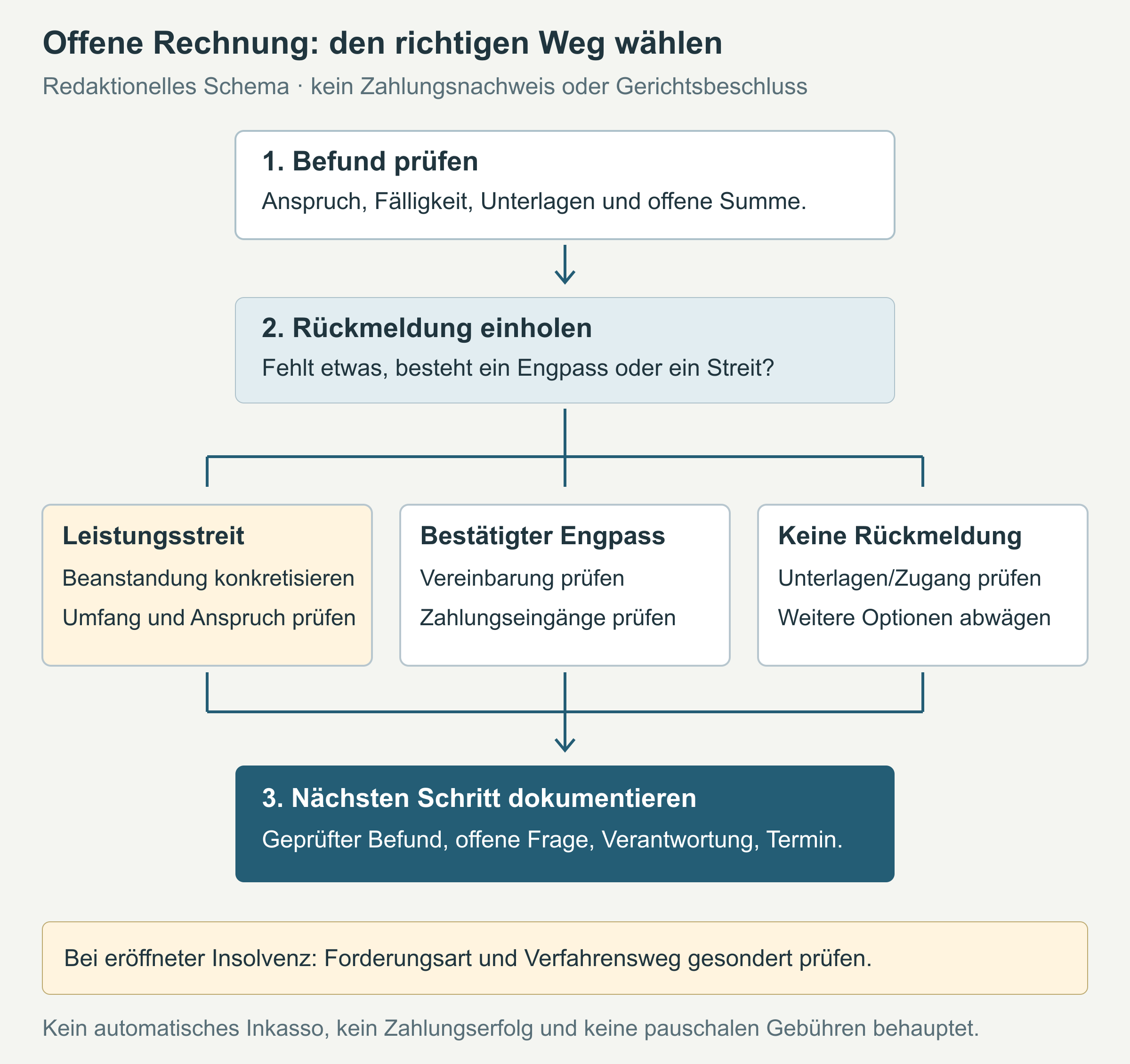
Findings → response → next step supported by the evidence. Our own decision guide, with no real case, payment received or court order. Deal with a dispute about the work separately.
Fictional example: €3,600 remains outstanding
An Austrian plumbing business has completed all the agreed work for a private customer without defects. The contract, records of the work and receipt of the invoice are documented. The validly agreed due date is 30 September 2026; on 5 October, the customer confirms that she has not yet transferred the balance. No insolvency proceedings have been opened in this example.
The agreed and invoiced total of €4,800 gross includes a €1,200 deposit that has been allocated to the invoice. That leaves €3,600 outstanding: 4,800 minus 1,200.
The customer reports a temporary cash shortfall and asks to pay in two instalments. The business can now assess whether it can afford the delay. The request alone does not create an agreement. The full fictional instalment example sets out the voluntary agreement and the dates for checking payments; it leaves open whether the payments arrive. Interest and costs are not included in the calculation.
Two instalments of €1,800 add up to exactly the outstanding €3,600. That calculation alone establishes neither an agreement nor receipt of payment. The business first needs to decide whether it is willing to accept this arrangement and record the terms with the customer. [b]
The full example sets two dates for checking payments: 15 and 30 October 2026. They are part of the voluntary agreement expressly assumed there. Whether either amount actually arrives is left open. For your own job, the equivalent is to agree when to check and then look at the account. [b]
If the customer instead alleges a defect, the assumptions change. The complaint then needs technical and legal examination; the instalment plan is not adopted automatically. [b]
If clarification does not produce a solution
If there is no response or an out-of-court solution proves unsuccessful, further recovery steps may be considered. The WKO describes options including debt collection and instructing a lawyer. [1] Before instructing anyone, make sure the task and costs are clear. Use the documents already checked and add the correspondence to date, including any objections.
The decision also depends on the likely effort involved in recovering the debt. A valid claim does not mean payment has been received. One person in the business should oversee progress so that several parties do not work on the same case in parallel. [b]
The detailed section on recovery explains the court process. For older invoices, clarify the limitation period in good time; another payment demand does not automatically interrupt it. [10] The assessment of interest and costs depends on the individual case.
Where insolvency proceedings have actually been opened, the next steps depend on the type of claim you hold. The guidance on opened insolvency proceedings explains the different cases. [11]
Record a specific task
Record what is established for the job and which response is still missing. Alongside it, note the person responsible and the next date for a check. This might mean confirming receipt of an invoice, arranging an appointment about a complaint or checking an agreed payment. Where payment has been promised, only its actual receipt changes the outstanding balance. A new response may make a different next step appropriate. [b]
You can use these fields for a brief note on the job. Update it after a response or payment. [b]
| Field | Entry for the specific job |
|---|---|
| Established position | Reconciled outstanding balance and recorded response. |
| Unresolved issue | Missing document, specific complaint or response not yet received. |
| Responsibility | Person in the business taking on the next task. |
| Date for checking | When to check an agreed payment or clarify the next issue. |
Sources checked for the previous version on 16 October 2026; editorially revised on 17 October 2026. Numbers link to sources; letters explain editorial examples or recommendations. Each note states what the source supports.
[b] Practical recommendations. The suggested processes and decision aids are editorial applications of the cited guidance. Their actual effect on enquiries or jobs has not been measured here.
Sources and context (11 sources)
- WKO: Zahlungsverzug des Geschäftspartners — Austrian Federal Economic Chamber
Explains due dates, out-of-court recovery and the differences between business and consumer transactions. This article does not reproduce numerical interest rates, base rates or flat fees. The organisational suggestions are editorial aids. Checked: 2026-10-16.
- ABGB § 1170: Entrichtung des Entgelts — RIS / Federal Chancellery of the Republic of Austria
Payment generally due after completion and statutory options for earlier claims for part payment. Does not decide the particular job or its contract terms. Checked: 2026-10-16.
- KSchG § 6a: Erfüllung einer Geldschuld — RIS / Federal Chancellery of the Republic of Austria
Timeliness of a consumer's bank transfer to a business, including where a date has been set in advance. Does not establish that a particular transfer has already been made or that a general payment period applies. Checked: 2026-10-16.
- WKO: Zahlungsverzug des Geschäftspartners – FAQs — Austrian Federal Economic Chamber
Explains timeliness, value dates and payment demands where payment is actually overdue. The competent court and any requirement for legal representation depend on the case; this article does not reproduce additional monetary thresholds, interest rates or fees. Checked: 2026-10-16.
- WKO: Zurückbehaltungsrechte — Austrian Federal Economic Chamber
Section 3 describes withholding outstanding payment for defective work and the limits of that right; the introduction covers B2B and B2C. A complaint alone does not always create such a right; the source does not decide an individual case or automatically release a supposedly undisputed portion for payment. Checked: 2026-10-16.
- ZPO § 244: Mahnverfahren — RIS / Federal Chancellery of the Republic of Austria
Claims solely for payment of money up to €75,000 and exceptions, including claims not yet due and a defendant based abroad. Not every monetary claim therefore falls within this procedure automatically. Checked: 2026-10-16.
- Bundesministerium für Justiz: Mahnverfahren — Federal Ministry of Justice / oesterreich.gv.at
Conditional order for payment without an initial examination of the merits of the claim; payment and objection time limits and the consequences of an objection. The text does not establish success in a particular court claim or actual receipt of payment. Checked: 2026-10-16.
- RIS: ZPO §§ 246, 248 and 249 – time limits and objections — RIS / Federal Chancellery of the Republic of Austria
Officially indexed extract from the consolidated version dated 29 September 2026: § 246 Z 2 (14 days after service), § 248 Abs 2 (four weeks from service) and § 249 Abs 1 (ceasing to have effect to the extent challenged). Retrieval of the full consolidated version timed out. § 248 was also read in full through its ELI; no full retrieval is claimed for §§ 246/249. Checked: 2026-10-16.
- ABGB § 1333: Gesetzliche Zinsen und weitere Schäden — RIS / Federal Chancellery of the Republic of Austria
Paragraph 2 refers to loss caused by fault, measures that are necessary and appropriate for their purpose, and proportionality to the claim. Does not establish that every fee charged is automatically recoverable. Checked: 2026-10-16.
- ABGB § 1497: Unterbrechung der Verjährung — RIS / Federal Chancellery of the Republic of Austria
Acknowledgement or a court action duly pursued, subject to the statutory conditions. The distinction from a mere payment demand is an inference from those conditions; the start and duration of the limitation period for a particular claim are not specified. Checked: 2026-10-16.
- USP / Justiz: Gläubigerinteressen im Insolvenzverfahren — Business Service Portal / Federal Ministry of Justice
Filing insolvency claims, the time limit in the insolvency notice, the bar on court actions/enforcement and the different process for claims against the insolvency estate. This simplified description does not replace classification of a particular claim by its legal basis and when it arose. Checked: 2026-10-16.