Full version with all templates and detailed checks. Back to the main article
Collecting Google reviews: How to ask customers for honest feedback
The handover of a finished bathroom is a good time to talk about working together. A customer might thank you for the tidy work. Or they might tell you that scheduling was difficult. An invitation to leave an honest Google review suits both experiences: customers decide whether to publish anything and what rating to give. [1]
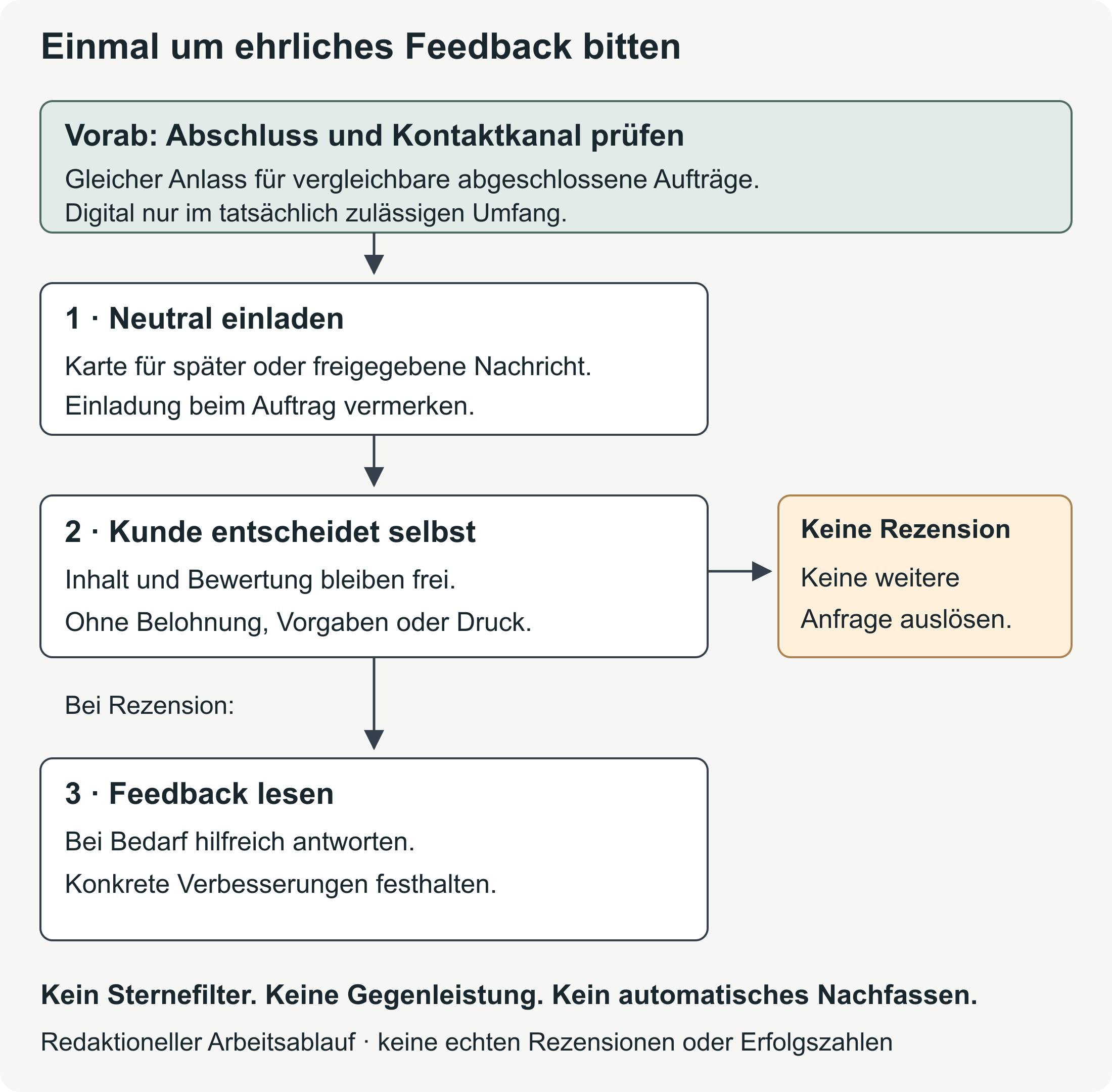
Once the agreed work is complete, make one neutral invitation for the customer to share their experience on Google. You need a permitted contact channel; for email, SMS or messaging apps, the templates require prior, demonstrable consent for that specific channel. [b]
Then record against the job whether the invitation was made or the customer declined. In our suggested process, this remains the only request, even if no reply comes. [b]
What a Google review shows
A review is visible to the public. Google displays it in Search and on Maps alongside the Business Profile, your business listing. Potential customers can read how other customers describe working with you. [2]
The service description on your website explains your offer from the business's perspective. A customer review adds a personal experience to that account. The author decides on the content and star rating. Google allows invitations to review real experiences, provided the business offers no incentives and does not try to influence the rating or content. [1]
To write a review, customers must be signed in to a Google Account. A Gmail address is not required; a Google Account can also be created using another email address. This is explained in Google Business Profile Help. [2]
You can make it easier to reach the review page. This cannot promise how many reviews will result or what star ratings they will contain, any more than it can promise particular revenue or a better position on Google. [b]
Google's rules for review requests
The Google policy on fake engagement and review manipulation sets clear limits on review requests. In particular, it prohibits: [1]
- fabricated or purchased reviews and artificially posting multiple reviews;
- money, discounts, gifts or anything else in return for a review, or for changing or removing a negative review;
- preventing negative reviews and selectively requesting positive reviews;
- requiring or pressuring customers to leave a review immediately on site, and specifying what they should write;
- requiring employees to request a certain number of reviews or to ask for specific content. [1]
An initial satisfaction question must not become a way to decide who receives the Google link either. This filter based on ratings, often called review gating, might direct only satisfied customers towards a public review. A question such as “How many stars would you give us?” must therefore not decide who receives the invitation. [1]
The right time
We suggest tying the invitation to completion of the agreed work. For a bathroom renovation, that could be the handover of the finished bathroom; for a repair, the end of the visit. By then, the customer knows the service and can connect the request to a particular job. No fixed time of day or deadline in days is needed. [b]
While work remains outstanding, the invitation waits. Once the business has completed everything agreed, criticism is no reason to invite a customer later than others. [b]
Any later complaint is handled independently of the review request. Remedial work, statutory warranty rights and resolving a problem must not depend on whether someone writes or changes a review. [b]
A process in five steps
1. Completion of the work
In the final conversation, establish whether the agreed tasks are complete. Record outstanding points against the job and explain to the customer who will deal with them. You do not need to estimate a satisfaction score. [b]
This conversation is part of completing the project, even if you do not ask for a review.
2. A permitted contact channel
Having an email address on file is not evidence of consent to a review request. The legal conditions for the digital templates are set out in the section on email and SMS. [3]
At the final conversation in person, a neutral card can offer a way to leave a review later. This does not ask customers to write their review immediately in front of a member of staff. [1]
| Situation | Appropriate step in the suggested process |
|---|---|
| Final conversation in person | Offer a neutral card for a voluntary review later. |
| Demonstrable consent to a one-off review request by email | Adapt the email template and prepare to send it on that basis. |
| Demonstrable consent to a one-off request by SMS or messaging app | Use the agreed channel and a free way to opt out. |
| Legal basis for digital contact unclear | Do not send a digital request; use the opportunity in person or establish whether the request is permissible in this particular case. |
| Customer has declined or objected | Do not send another review request. |
3. A short, neutral invitation
For a request in person, thanking customers for the job and mentioning the option of a voluntary review is enough. Customers can take the card away, decide later or decline the invitation without giving a reason. The team should neither wait for a review nor take the customer's smartphone. [b]
Wording such as “Five stars, please” or “Mention our employee” interferes with the rating or content. Such instructions go against Google's rules. [1]
4. A note against the job
You can add the note to your existing job list; you do not need dedicated review software. Colleagues need to be able to check whether the work is complete, which contact channel was intended, and whether the invitation has already been made. Record refusals too, so that no one asks a second time. [b]
| Field | What it is for | Sample factual entry |
|---|---|---|
| Job reference | Find the note against the right job | Internal job ID |
| Completion point | Check when the work was completed | Completion date or outstanding work |
| Contact channel | Identify the intended permitted channel | Card / one-off email / one-off SMS |
| Consent for a digital request | Find the scope and evidence of consent | Channel, purpose, time and reference to evidence |
| Invitation | Prevent a second request | Pending / card offered / sent once |
| Refusal or withdrawal of consent | Stop further requests | No further request |
| Person responsible | Assign follow-up questions within the team | Person responsible within the business |
Consistent labels help colleagues hand work over to each other. An estimated satisfaction score has no place in this decision. The process does not require public reviews to be matched to individual customers either. [b]
Only the people responsible should have access to the list. The business's data protection rules should set out which evidence is needed, for how long, and when notes that are no longer needed will be deleted. The principles of data minimisation, storage limitation and confidentiality apply. The Austrian Data Protection Authority explains these duties for controllers. [4]
5. One invitation without a follow-up
We recommend one invitation without a follow-up. Even if no reply comes, there is no automatic reminder or search for a particular customer's review. The team can focus on the content of new feedback. [b]
A particular star rating is not a target for the team. A specific task, such as making documents easier to understand or scheduling clearer, is more useful for the next handover. [b]
Email and SMS in Austria
Direct marketing addresses individual recipients directly, for example by email or SMS. For electronic messages serving this purpose, § 174(3) TKG 2021 generally requires prior consent. [5]
Paragraph 4 contains an exception for existing customers. All of the following conditions must be met:
- The sender obtained the contact details in connection with a sale or service to its customers.
- The message promotes the sender's own similar products or services.
- The recipient had a clear, simple and free way to refuse this use of their contact details when those details were collected. This option is also available with every message.
- The recipient has not refused the messages from the outset, in particular by being entered on the list under § 7(2) E-Commerce-Gesetz. [5]
The conditions are set out in § 174 TKG 2021 in the RIS. A previous job alone therefore does not establish whether the exception covers a particular review request.
The WKO describes direct marketing as a broad term. Market and opinion research falls outside it only if it is not intended to promote sales directly or indirectly. A request for a public Google review therefore cannot automatically be treated in the same way as an internal satisfaction survey. The guidance on advertising by telephone, email and SMS explains this distinction. [6]
The digital templates below are based on prior, demonstrable consent to a one-off review request through the respective contact channel. They do not rely on the existing-customer exception. If the relevant evidence is missing, no digital request is sent. [b]
Consent must be voluntary, active and clearly worded. Customers need information on how their data will be used and their right to withdraw consent at any time. This includes, in particular, the purpose and retention period, as well as possible recipients of the data. Consent should be documented. An unauthorised marketing email intended to obtain this consent is not a permissible starting point. [3]
The finished message also needs an identifiable sender and a working address for requests to stop such messages. [5] Opting out must be free and simple. A charged reply SMS alone is not enough. The WKO explains these requirements in its guidance on data protection in direct marketing. [3]
Four sample invitations
The following invitations are suggested wording from BrandHoop. Customers write their own reviews. Replace the details in square brackets with the relevant business information; the review link and free way to opt out must work before use. [a]
Sample 1: Invitation in person with a card for later
Thank you for working with us. If you would like to, you can share your experience with our business on Google later. Here is a card with the link or code for leaving a review. Whether you write anything, and what you write, is entirely up to you.
You can mention the completed service in your thanks, for example, “Thank you for choosing us to renovate your bathroom”. The invitation stays the same for praise and criticism.
Sample 2: Wording for a printed card
Your experience with [Business name]
Would you like to share your experience with our business on Google? The link or QR code on this card takes you to the review page. Your feedback is voluntary. You decide what to write.
Thank you for working with us!
[Business name]
[Checked review link or QR code]
The card can go with the handover documents. Customers can take it away and decide later. The text asks for neither a positive nor an immediate review.
Sample 3: Email after a completed job
This template requires the prior consent described above for the one-off email. Include your full business signature at the end. The reply address must actually work so that the stated way to withdraw consent is available.
Subject: Voluntary Google review of your job with [Business name]
Hello [Name],
thank you for choosing us for the job. The agreed work on [brief description of the service] is complete.
You consented to a one-off review request by email. If you would like to, you can share your experience with our business on Google:
[Checked review link]
Leaving a review is voluntary. You decide on the content and rating. Even if you do not write a review, you can contact us as usual with questions about the job.
Kind regards
[Name and full business signature]
You can withdraw your consent at any time. Simply reply to us with “No review requests”; opting out is free.
Customers can also contact you directly with questions about the job. This must not be used to steer customers with criticism away from the Google link. Wording such as “If you were happy, leave us a review; otherwise, write to us” would make precisely that selection. [1]
Sample 4: Short SMS or messaging app message
Here too, prior consent applies to this specific contact channel. Before use, the template needs a working, free way to opt out.
Hello [Name], thank you for choosing [Business name] for the job. As agreed, this is our one-off invitation to leave a voluntary Google review. Share your experience here: [checked review link]. Prefer no further requests? Opt out: [free way to opt out].
Other contact details on file are not a reason to invite the same customer again by email and messaging app. [b]
A fictional example involving criticism
A small trades business hands over a fully renovated bathroom. All agreed work is complete. The customer says she found the scheduling difficult. The person responsible records the criticism and discusses with the team how to improve the planning.
The customer receives the same neutral card as other customers. She can mention the scheduling problems in her review. The business does not wait for a more favourable opinion before making the invitation. As there is no consent to a digital request, no email follows.
The job record says: “Complete; card offered; no follow-up.” Any later complaint is handled as usual. Resolving it does not depend on the review. The business does not ask for the review to be changed either.
The case is fictional and shows how the suggested process can be applied when there is criticism. Whether the customer actually publishes anything remains open. [a]
Review link and QR code
A review link takes customers to the option of reviewing the business on Google. A QR code provides the same access by scanning. Google describes both methods in its Business Profile Help. [2]
Before printing a card, it is worth testing it on a smartphone: the link and scanned code must lead to the right business. The card text must also be readable. The guide to review links and QR codes explains how to create and check the link and code. [b]
Use feedback in your business
The content of feedback can lead to specific tasks. If scheduling comes up repeatedly, that process is a good subject for a team discussion. If handover documents are unclear, focus instead on the information customers receive at the end. The person responsible records what the business wants to change and who will take care of it. [b]
A few questions can help when reviewing the process together:
- Does the team know when a job is complete?
- Does the invitation stay the same for customers with different experiences?
- Does the note prevent duplicate requests and further messages after a refusal?
- Is the permitted contact channel for digital requests traceable?
- What specific improvement follows from the feedback?
A public reply is useful when it adds helpful or new information. Google recommends short, polite replies; there is no need for a public thank-you beneath every review. Replies must not publish private customer data. [2] You can find suggested wording in the examples of replies to Google reviews.
How to start with your team
Prepare suitable wording for your card and work through one sample job involving praise and another involving criticism with the team. This helps establish who will make the invitation and keep the note in the job list. [b]
The table in step four provides a template. For the next completed jobs, you can check whether refusals are recorded and no one is asked a second time. [b]
Sources and guidance for checks
The linked Google help pages explain the platform rules. For electronic requests in Austria, § 174 TKG 2021 and the WKO guidance on direct marketing are relevant; the Data Protection Authority explains the duties involved in processing personal data.
Sources checked as at 16 October 2026. The chosen timing, list of fields and process with one invitation are editorial working aids. The templates and bathroom renovation case contain no real customer data.
Sources for the previous version checked as at 16 October 2026; editorially revised on 17 October 2026. Numbers lead to sources; letters explain editorial examples or recommendations. Each note states what the source supports.
[b] Practical recommendations. The suggested processes and decision aids are editorial applications of the principles cited. Their specific effect on enquiries or jobs has not been measured here.
[c] Editorial illustration. The illustration shows how things relate. It is neither a real customer reference nor evidence of a measured effect.
[a] Editorial examples. Content labelled as a sample or fictional illustrates possible situations. These are not real customer cases or evidence of a measured effect.
Sources and context (6 sources)
- Verbotene und eingeschränkt zulässige Inhalte — Google
Confirms the requirement for real experiences and the bans on fabricated or purchased reviews, artificially posting multiple reviews, incentives, preventing negative reviews or selectively requesting positive ones, prompting or pressuring customers to review on site, and specifying review content. Also prohibits requiring employees to request a certain number of reviews. Using the same completion point and making exactly one invitation without a reminder are editorial suggestions for applying the rules; the policy does not prescribe them as a fixed procedure. Checked: 2026-10-16.
- Tipps für mehr Rezensionen — Google
Confirms that reviews appear in Search and Maps, that a Google Account is required but a Gmail address is not, and that a link and QR code are available. Also provides guidance on helpful public replies and protecting private data. Does not establish the effect of an individual invitation or any increase in revenue, star ratings or rankings. Checked: 2026-10-16.
- Direktwerbung Datenschutz: DSGVO richtig umsetzen — Wirtschaftskammer Österreich
Confirms the requirements for clear, voluntary and active consent, information on data processing and withdrawal of consent, the recommendation to document consent, and a free, simple way to opt out. Explains that an unauthorised first marketing email is not a way to obtain consent and that consent applies only within the agreed scope. The four invitation texts and the limit of one message are our own templates. The point about a charged reply SMS follows from the requirement for a free way to opt out; the WKO does not give this specific SMS example. Checked: 2026-10-16.
- Ihre Pflichten als Verantwortliche:r — Österreichische Datenschutzbehörde
Confirms data minimisation, storage limitation, confidentiality, protective measures appropriate to the risk, and the ability to demonstrate compliance. Limiting access to the list to the people responsible is a practical application. The authority gives no specific retention period for review notes in this source; the template claims no such period. Checked: 2026-10-16.
- Telekommunikationsgesetz 2021 § 174 – Unerbetene Nachrichten — Republik Österreich / Rechtsinformationssystem des Bundes
Paragraph 3 confirms that prior consent is generally required for electronic direct marketing, including SMS. Paragraph 4 sets out the four cumulative conditions for the exception; paragraph 5 requires, among other things, an identifiable sender and a genuine address for requests to stop the messages. This provision alone does not determine the legal classification of every particular Google review request. The templates explicitly use prior consent as their basis. Checked: 2026-10-16.
- Werbung per Telefon, Fax, E-Mail und SMS: Was ist erlaubt? — Wirtschaftskammer Österreich, Fachverband Werbung und Marktkommunikation
Confirms the broad definition of direct marketing and the distinction from market and opinion research that does not promote sales directly or indirectly. The article cautiously applies this distinction to review requests; the WKO page does not give a blanket ruling on every possible Google review request. Checked: 2026-10-16.