Regional market analysis: assess demand and competition in your service area
Reading time: about 5 minutes for the main text. Use templates and details as needed.
Full version with templates, calculations and further checks
Adding another municipality to your website is easy. First, you need to establish whether your business can take on suitable work there and what prospective customers need to know. Start with a service you already offer and a manageable area. This gives you a reasoned basis for deciding whether to improve the existing service page, answer a separate question on a new page or first run a limited test in the area. [b]
This regional market analysis supports website planning. It cannot give you a reliable number of future jobs. The bathroom renovation example below is entirely fictional; no local demand was measured for it. [a]
Choose a service and an area you can serve
Start with work your business actually takes on. Complete bathroom renovations for private property owners are different from repairs or an emergency call-out service. Keep these offers separate in your research. Who commissions the renovation matters too: a property manager may need different information from someone having their own flat remodelled.
List the municipalities you want to serve. Ask the same operational questions for each one: are travel times reasonable for the size of the job? Do you have enough capacity for this service? High search interest would not make an impractical journey profitable. The WKO also includes internal business factors in market research. [2]
Also note what each time reference means. A population figure applies to a reference date; search data may summarise a past period. Record the start and end of your planned test separately. This lets you assign later contacts to the right evaluation without treating different time references as the same measurement. [b]
In the fictional example, a plumber is considering offering complete bathroom renovations in municipalities A and B. She first checks travel times and the resources available. For the first trial, she chooses one municipality so that she can attribute the effort and enquiries to this test. A and B are placeholders; your website should name the places you actually serve. [a]
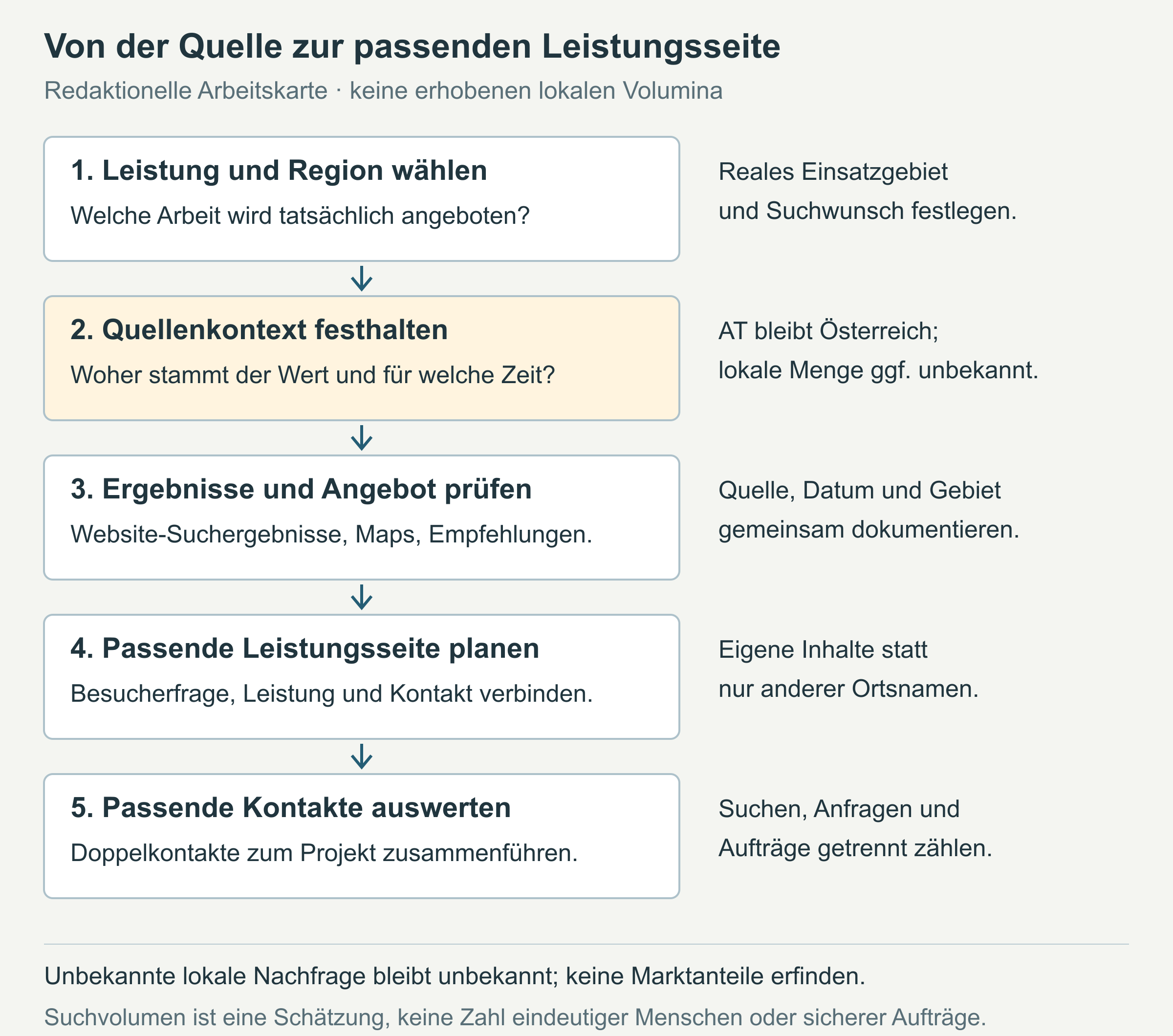
Record sources with their area and time period
A small table is enough to start with. Record your question and the source. Alongside them, add the area, the period or reference date, and the limits of what the information tells you. These entries should show what you know and what remains open. The blank template and completed sample can be used for this.
This extract from the original research matrix shows possible entries for the fictional bathroom renovation example. It contains no collected local findings. [a]
| Question | Data / source | Geography / time period | Limitations | Conclusion / next test |
|---|---|---|---|---|
| Which households fit the offer? | Statistik Austria; metric as defined in the table | Municipalities A/B; reference date as stated in the table | Does not establish need or who is responsible for commissioning the work | Narrow the target audience; explore open questions in conversations |
| Do previous contacts fit the offer and area? | Internal enquiry overview | Your own business; defined period | Only contacts already reached; selection may be biased | Evaluate suitable and unsuitable projects separately |
For each source, include its link or internal location and the date you accessed it. Label something you have actually established as an observation. An approximate figure remains an estimate; an idea you still need to test is a hypothesis. An unanswered question can remain in the table. [b]
For municipal data, Statistik Austria provides “Blick auf die Gemeinde”. Each table shows which information is available. [6] But a count of existing buildings does not tell you how many bathroom renovations are coming up. Nor does the number of residents tell you who currently wants to commission work.
Search volume describes the estimated number of searches in the stated area and period. One person may search more than once, so it tells you neither the number of people nor the number of jobs. [3] [1] Ahrefs describes average monthly searches in the selected country over the last twelve months. An AT figure applies to Austria. Even for the keyword “Badsanierung Wien”, it does not measure demand in Vienna. [1]
Always record the area and period alongside each figure. Where local data is missing, leave the entry as “local quantity unknown”. Do not allocate the Austrian figure in proportion to population. The detailed guidance on search tools will help you read an export.
Compare other providers using the same questions
Search for the chosen service in the intended area. One starting point is WKO Firmen A–Z with its search by business and location. [11] Then read the websites of the businesses you find.
Compare the same scope for each provider: do they take on complete bathroom renovations or individual tasks? Which service area do they name? What project references and contact details do they show? Record the search term, search location and date. Count each business once in your overview, even if you find it in both search results and Maps. [b]
Separate providers of the same main service from businesses that take on only part of the work. Keep individual locations identifiable. A business based outside the municipality may also work there; a local branch may cover only part of the service you are researching. Leave missing website information as an open question. An absent description does not reliably establish the full scope of an offer. [b]
The pages show you the publicly described offer. Available capacity remains unknown. And a small number of visible results does not prove a gap in the market. Low visibility for your own business on Maps may also call for a profile check; Google lists relevance and distance among the factors involved. [12] For this, use the Business Profile checklist.
Use unanswered customer questions to decide which page you need
The plumber now looks at her existing service page. Can private property owners see which work she takes on and whether she serves municipality A? Is the next step towards a discussion clear? If either piece of information is missing, she adds it to the existing page first. [a]
On this page, she also explains what needs to be clarified before the renovation can be assessed. Projects cleared for publication or the business’s own regional information can make its connection to the area clear, where these are actually available. The contact section states which details the business needs to process an enquiry. This lets a prospective customer describe their project without already knowing the internal process. [b]
Apply the same check to a new page: it needs its own visitor question and relevant information from the actual offer. A place name alone is not enough reason for another page. Google gives regionally targeted pages that send visitors to the same destination page as an example of doorway abuse. [13]
Compare the two options against the information people need. If the service page already answers the question, improve the explanation there. If a separate question needs more space, an additional page may be appropriate. The page planning guide for trades businesses shows how to connect your offer with a way to get in touch. [b]
A guide can discuss bathroom renovation options in more detail. Someone who is already comparing contractors needs information on the specific scope of work and service area. Choose the page type to suit that need. An additional search phrase alone does not call for another text with almost identical content. [b]
Prepare and evaluate a limited test
Before the test, the plumber sets the period and decides who will handle enquiries. She starts by choosing one route to the page, such as Google Search or the existing Business Profile. Here, a suitable enquiry concerns a complete bathroom renovation in municipality A and includes enough information for the next assessment. [a]
Alongside the project, she records where the contact came from, as far as this is known. She also notes the working time required. If she uses advertising as well, she documents its budget and period separately. Before starting, she uses her capacity and cost calculations to decide what result would justify continuing. [a]
Count each project once. A phone call and a form message about the same renovation count as one project enquiry. In the fictional calculation, merging duplicate contacts leaves 20 project enquiries; 8 meet the criteria. 8 ÷ 20 = 40% describes the proportion of suitable enquiries among these hypothetical contacts. The numerator and denominator refer to the same test period and the same project definition. This does not measure jobs or market share. [a]
The reasons behind the remaining enquiries also help with the next decision. Were people asking about a different service, or was the project outside the area? This indicates which information on the page needs to be clearer. The business still has to turn a suitable enquiry into a job. [b]
Decide in advance how much effort your business can afford and when you will continue or pause. Check why unsuitable contacts do not fit. If messages fail to arrive, use the form testing procedure to check delivery as well. A short test with few contacts does not prove an absence of demand across the whole area.
When comparing results with the starting point, take the season and any changes to the offer into account. An increase in suitable contacts after a page change does not, by itself, prove that the change caused it. What matters for the next trial is the question that remains open: how clearly the offer is explained, how people reach the page or whether the message arrives at the business. [b]
Now record your chosen service and municipality. Add the most important unanswered customer question and decide which page or contact route to work on first. A date and a named person turn this into the next concrete task. [b]
Editorial version dated 16 October 2026. Numbers link to sources; letters explain illustrative examples or recommendations. Each source note states what the source supports.
[a] Illustrative examples. Content labelled as a sample or fictional illustrates possible situations. It does not describe real client projects or provide evidence of a measured effect.
[b] Practical recommendations. The suggested processes and decision aids are editorial applications of the principles cited. Their specific effect on enquiries or jobs has not been measured here.
Sources and context (13 sources)
- What is the difference between Traffic potential and Search volume in Keywords Explorer? — Ahrefs
Defines Search Volume as average monthly searches in the selected country over the last twelve months and distinguishes it from Traffic Potential. The limitation on municipal interpretation follows from this unit of measurement. No Ahrefs tool was queried and the historical AT value of 10 from 12 October 2026 was not updated. Checked: 2026-10-16.
- Marktforschung — Wirtschaftskammer Österreich
Describes areas of market research, including internal business capacity. Does not provide measured regional demand or promise website results. Checked: 2026-10-16.
- Keyword-Planer: Prognosen — Google Ads
The sections on historical metrics define monthly searches including close variants, period, location and network, rounded volumes and competition among advertisers. No new forecast, keyword list or local measurement was created. Checked: 2026-10-16.
- Kennzahlen der Marktanalyse – SPIRIT Toolbox — Universität Trier / SPIRIT
The three-page PDF was read as text. Its definitions of market volume and market potential, and the relationship between quantity and price, are used; their application to trades projects is editorial. It is not a source for actual project numbers or regional renovation rates; the underlying book was not read. Checked: 2026-10-16.
- Sekundärforschung – Marketing-Baukasten — Bibliotheksportal
The original methods guide by Jens-Christoph Krauß and Marina Schnathmann, produced in collaboration with Prof. Ursula Georgy, was read. It is used solely to distinguish existing data from newly collected information. Its context is libraries; none of its market or usage figures are used, and it provides no evidence of results for trades businesses. Checked: 2026-10-16.
- Blick auf die Gemeinde — Statistik Austria
Confirms the availability of regional data and comparisons between municipalities, districts and federal provinces. The service description was read; no municipality was selected and no local metric or demand for bathroom renovations was measured. Checked: 2026-10-16.
- Regionale Gliederungen — Statistik Austria
Explains administrative units and other regional divisions. A business’s service area based on travel time must be defined separately; no administrative or population figures were incorporated into the article. Checked: 2026-10-16.
- Quick-Guide: Die wichtigsten Schritte zur Marktanalyse — Wirtschaftskammer Österreich
Recommends cross-checking several sources and examining a clearly defined market in a structured way. Does not provide evidence of a specific gap in the market or the measurable success of a test. Checked: 2026-10-16.
- Häufig gestellte Fragen zu Google Trends-Daten — Google
Supports the use of a sample, normalisation by location and time, a relative scale from 0 to 100 and the display of small volumes as 0. No Google Trends query was made; it provides no count of people, renovations or jobs. Checked: 2026-10-16.
- How accurate is keyword search volume in Ahrefs? — Ahrefs
Confirms that search volumes are estimates and cannot be directly equated with traffic. Percentages from the provider’s own studies cited on the page were not used or generalised as data for trades businesses. Checked: 2026-10-16.
- WKO Firmen A–Z — Wirtschaftskammer Österreich
The public homepage and its search term and location fields were checked, including the redirect to SearchSimple.aspx. No real businesses were searched for, no complete competitor count was made and no capacity or market share analysis was carried out. Checked: 2026-10-16.
- Ranking in lokalen Suchergebnissen auf Google verbessern — Google Business Profile
Confirms relevance, distance and prominence/popularity as the main local ranking factors, and the importance of accurate profile information. Observed visibility does not establish market share or the scale of local demand. Checked: 2026-10-16.
- Spam policies for Google web search — Google Search Central
Only the Doorway abuse section is used, particularly pages targeting regions that lead to the same destination page. The editorial recommendation on useful location pages does not mean that every similar location page automatically breaches the policies. Checked: 2026-10-16.