Full version with all templates and detailed checks. Back to the main article
Regional market analysis: assess demand and competition in your service area
Your business is considering serving another municipality. Before you create a new page for it, there are some practical questions to answer. Are the travel times reasonable? Which work do you want to take on there? And what would prospective customers need to know about your offer before making an enquiry?
A regional market analysis can help prepare this page plan. Start by defining the service and area you will cover. Then look at existing data and what other businesses offer. Unanswered customer questions show what your website should explain. Whether this generates suitable enquiries belongs in a separate evaluation later. A search figure for the whole of Austria does not describe demand in an individual municipality. [1]
This BrandHoop guide is for small trades businesses in Austria. It focuses on service pages and local SEO: how people find your business in the region. The bathroom renovation example is entirely fictional. It contains no measured local search figures, market shares or results from a real client. [a]
If you already know your question, you can use the blank table to get started. The fictional example with 8/20 suitable enquiries then shows what a limited evaluation might look like.
What the analysis helps you decide
A regional analysis for your website needs a manageable question. For a bathroom renovation page, this might be what private property owners want to know before enquiring and which locations the business actually serves. Defining the service, target audience, area and period sets out the target market you are examining.
The WKO describes market research as the study of demand, target audiences and competition. It also covers sales channels, internal business factors and the market environment. [2] Your business must be able to deliver the stated service in the area named. That is why travel times and available capacity belong at the start of the discussion.
Research can show which information is already available for this decision and which questions remain open. Assessing whether someone currently wants to commission work requires further evidence. A search figure alone cannot tell you your future workload or revenue growth either. The next useful step may be a clearer service description, or a small test before deciding on a wider service area.
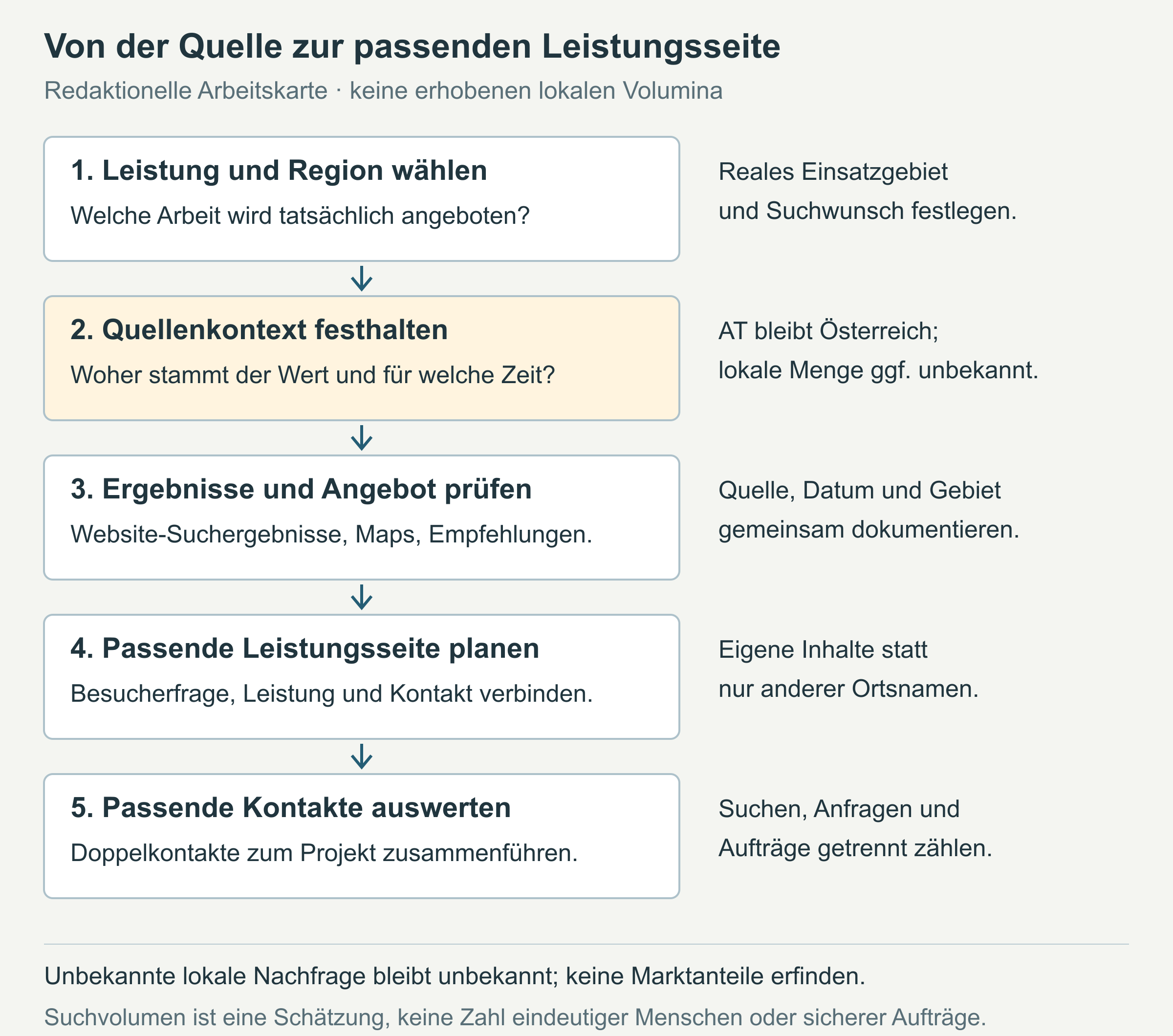
Define the service and area you cover
Complete bathroom renovations for private property owners are a different task from repairs, heating installations or an emergency call-out service, for example. Keep your research focused on the selected service. Someone looking for a repair is not necessarily planning a complete bathroom renovation.
Your target audience also depends on who decides and pays. Flat owners, landlords and property managers can have different requirements, even for similar buildings. For page planning, consider what each person needs to know before the first discussion. Budgets and the timing of decisions may differ too.
Your service area covers the places where your business wants to work. A list of municipalities, districts or postcode areas makes this boundary clear. Whether a journey is worthwhile depends on your service and the size of the job. An entire federal province may suit some businesses; for others, that area would be too large. Search data cannot replace this operational decision.
Time references need a clear meaning too. A reference date describes a specific day; an observation period covers a past stretch of time. Your planned test period, by contrast, is still ahead. A population figure and average monthly searches over a year cannot be treated as two measurements of the same thing.
A useful research brief might be: “We are checking whether additional enquiries for complete bathroom renovations from municipalities A and B fit our offer and capacity.” Municipalities A and B are placeholders. In your own research, use the places you actually intend to serve. [a]
Distinguish searches, people and jobs
When reading a figure, first check what is being counted. Search volume describes searches in a stated area and period. It cannot be used to derive the number of unique people or jobs commissioned directly. [3] [1] For your website work, these distinctions help:
| Measure | What it describes | What it does not establish |
|---|---|---|
| Searches | Searches for a term in the stated area and period | Number of unique people or jobs |
| Potential customers | People, households or businesses that could, in principle, fit your target audience | Current purchase intent, budget or commissioning of work |
| Market size | Jobs or revenue per year in the defined market; state whether you measured them or calculated scenarios using assumptions | Your business’s revenue or demand you can reach online |
| Possible enquiries for your business | Contacts your business could reach through measurable routes; forecasts require assumptions | Conversion rate, market share or a guaranteed future workload |
Market volume means the jobs actually completed or revenue generated in the defined market and period. Market potential describes the maximum possible quantity or revenue under certain conditions; purchasing power also matters. The University of Trier explains these market measures in its start-up toolbox. [4] Potential is therefore not a result your business has already achieved.
To estimate revenue, you need a justified number of projects for the period and an appropriate value per job. [4] The number of existing homes does not tell you the annual number of bathroom renovations. Nor does a building’s age reveal when its bathroom was last renovated or who decides on the work.
If this information is missing, the calculation remains a scenario with explicitly stated assumptions. A range can make different assumptions visible. Extra decimal places cannot make up for missing data. For your page plan, it is therefore acceptable to conclude that the local quantity remains unknown for now.
Collect data for the right area
Existing statistics and documented information are a useful starting point. Analysing this data is called secondary research. Collecting new information for your own question, for example through conversations or a limited survey, is primary research. The methods guide on Bibliotheksportal also explains this distinction. [5] For your research, the deciding factor remains which question a source actually answers.
The “Blick auf die Gemeinde” service from Statistik Austria provides regional data and lets you compare a municipality with its administrative district and federal province. [6] The overview “Regionale Gliederungen” describes territorial units such as municipalities, districts and federal provinces, as well as other divisions. [7]
For bathroom renovations, information on population, households, buildings and homes can be a starting point. The relevant table will show whether the metric you need is available for your area. Include the reference date and exact definition in the entry. A municipal overview does not automatically describe the area your business can reach within a given travel time, either. When combining several areas, do not count overlaps twice in the total.
Your own enquiries and jobs add to this picture. Grouped by area, service and period, they show which projects your business has reached so far and which were suitable. This slice of information can support page planning. It does not represent the part of the market you have not yet reached.
The WKO Quick-Guide on market analysis recommends using several sources to cross-check information. [8] The measures need to match for this to work. A similar figure is of little use in a comparison if it describes a different target audience, region or period. This is particularly relevant for search tools, whose metrics are defined differently.
Google Trends: compare search interest
Google Trends uses a sample of searches. The data is normalised by location and time and displayed on a scale from 0 to 100. The index shows relative search interest. The same value in two regions does not mean that the same number of searches took place there. The Google Trends help page explains this calculation. [9]
Terms with low search volume may appear as 0. Such a value does not prove an absence of demand. [9] You can use available data to investigate developments or possible seasonal patterns for your planning. A spike tells you neither the number of buyers nor the proportion of homes renovated.
Keyword Planner: understand settings and metrics
Keywords are words or phrases people use to search. Average monthly searches in Google Keyword Planner include the keyword and close variants. The value depends on the selected period and the location and search network settings. Search volumes are rounded. [3]
The “Wettbewerb” (Competition) column describes competition among advertisers bidding on keywords. It does not count local trades businesses. [3] Competitor research therefore requires a look at the actual providers and their services.
In an export, the selected area and period remain part of the figure. If the dataset covers the whole of Austria, it contains Austria-wide search data. Even the phrase “Badsanierung Wien” in an AT dataset does not give you the number of searchers living in Vienna.
You cannot add several keywords together to get a customer count, either. One person may use different phrases, and close variants can overlap.
Ahrefs AT: figures for the whole of Austria
Ahrefs calls its search volume metric Search Volume. In Keywords Explorer, it describes average monthly searches for a keyword in a selected country over the last twelve months. Ahrefs explains the metric and how it differs from Traffic Potential. [1] The “AT” setting stands for Austria. A place name in the keyword does not turn this country-level figure into a measurement for the district or municipality.
Ahrefs also points out that search volumes are estimates and cannot be translated directly into website visits. [10] The explanation of search volume accuracy describes this limitation. Traffic here means website visits; it still does not establish a number of jobs.
Where local figures are missing, “local quantity unknown” is a useful entry. Allocating AT volume in proportion to population would assume a local search frequency you have not measured. The city in a search term does not, by itself, tell you where the person searching lives either.
Compare competitors’ offers
A clearly defined service and region also let you examine the competition more closely. The public directory WKO Firmen A–Z offers a search by business and location. [11] Search results and the websites of the businesses you find provide further clues. Those websites are where you can read which work a provider explicitly describes and which area they name.
Record the search term, search location, date and source so that the comparison can be understood later. These questions help:
- Does the business offer complete bathroom renovations, individual trades or the coordination of several tasks?
- Which service area does it name, and where does it overlap with your target market?
- Which target audience and specialism does the website describe? What verifiable project references does it show?
- Which contact options and information help prospective customers assess the offer?
- Which details are missing, leaving a conclusion open?
You may encounter the same business through several routes. Count it only once in the overview, while keeping individual locations identifiable. Here, direct competitors are providers of the same main service. Providers of part of the work or other solutions may also matter if customers use them to solve the same task.
A website shows the public description of an offer. It does not give you reliable information on the business’s full order book or available capacity. Nor is the number of pages you find a complete count of providers or a measure of market share. A business from outside may work in the area you are studying, while a local branch may cover only part of the service you are looking for.
The statement “There are few specialist providers” therefore remains a hypothesis at first: an idea that needs further checking. Perhaps most jobs come through referrals, property managers or existing contacts. A SWOT overview can organise these ideas into strengths, weaknesses, opportunities and threats. Each assessment in it should be traceable to the documented observations.
Compare Google Search, Maps and referrals
A channel here is a route through which people find the business. Keep the service and region the same across all routes for a meaningful comparison. Each entry should include the search term, search location, date and visible source. The table organises these observations; it is not a measured ranking of competitors. [b]
| Channel | What you observe | Next question to check | Data limitations |
|---|---|---|---|
| Website search results | Which pages appear for the selected search query and how they explain the offer. | Which visitor question does the page answer, and which project reference and contact route help? | The results shown do not include every provider or job. |
| Google Maps / Business Profiles | Which services, regions, contact details and reviews the profile shows. | Does the profile describe the same business, and do its arrangements for receiving customers fit the offer? | Visibility depends on factors including relevance, distance and prominence; it does not establish market share. |
| Referrals and existing contacts | How the people enquiring found the business, where this is documented for each project. | Which service and region fit? Can you identify the project clearly and count it only once? | Contacts already reached do not form a representative cross-section of all households. |
For local search results, Google mainly lists relevance, distance and prominence or popularity. [12] If your business rarely appears on Maps, the cause may lie in the profile or how it matches the search. Low visibility does not prove a lack of demand. For your existing listing, the Google Profile checklist, used before drawing conclusions about the market from what is displayed, can help.
Template: record questions and sources
One shared table keeps the research manageable. Each row connects a question with its source and the area the information covers. Alongside it, leave room for the limits of what it tells you and the next test. This keeps an open assumption visible when you move on to page planning.
The six completed rows show a fictional bathroom renovation example. They contain no collected findings or actual local market metrics. [a]
| Question | Data / source | Geography / time period | Limitations | Conclusion / next test |
|---|---|---|---|---|
| Which households fit the offer? | Statistik Austria; metric as defined in the table | Municipalities A/B; reference date as stated in the table | Does not establish need or who is responsible for commissioning the work | Narrow the target audience; explore open questions in conversations |
| Who offers complete bathroom renovations? | WKO Firmen A–Z; providers’ websites | Area of the analysis; research date | Providers and capacity are only partly visible | Count each business only once; check the service on its website |
| Are people searching for the service? | Keyword Planner; export including location | Available region; selected months | Rounded searches; not a count of individual people | Check search intent; plan a small test |
| Is search interest changing? | Google Trends; same selection | Available region; same period | Relative index; small volumes may be missing | Check the seasonal hypothesis against other sources |
| Do previous contacts fit the offer and area? | Internal enquiry overview | Your own business; defined period | Only contacts already reached; selection may be biased | Evaluate suitable and unsuitable projects separately |
| Is the new region financially viable for us? | Internal planning: travel time, capacity, projects | Municipalities A/B; planned work | The result depends on your own assumptions | Run a limited test in one area; measure effort and suitability |
Blank template to copy
Use the blank table for your business’s actual questions about page planning or visibility. Under “Limitations”, record what the source leaves open, even when it fits the question well.
| Question | Data / source | Geography / time period | Limitations | Conclusion / next test |
|---|---|---|---|---|
Each source needs a link or internal location and the date you accessed it. You can classify information as an observation, estimate or hypothesis. An observation is something you have actually established; an estimate is an approximate figure. A hypothesis still needs testing. “No suitable data available” is also a valid entry. It makes clear which question the next test should answer.
Plan the right service page
The research first produces a set of questions about the service your business actually offers. For the website, what matters is the task a visitor wants to complete. Someone comparing providers needs different information from someone who is only beginning to look at bathroom renovation options. A guide and a service page can address these needs in different levels of detail.
A customer might want to know whether an accessible solution is possible, for example, or what sustainability means for the work on offer. Actual customer questions and further information should indicate whether these topics matter to your target audience.
The service page should make clear which work your business takes on and what needs to be clarified before an assessment. That includes the area you actually serve. Your own regional information or projects cleared for publication can explain the connection to a place. The contact section follows on from this: visitors need a clear next step and an explanation of which details your business needs to process the enquiry. Internally, it must be clear who will handle it.
Whether you need a new page depends on the existing content. If the current service page already answers the question, you can improve the explanation or contact route there. An additional page needs its own clearly distinct topic. The page planning guide for trades businesses shows one possible structure.
A location page covers a particular municipality or city. It is useful when it answers a distinct visitor question there with accurate information. Identical text with the place name swapped does not provide that explanation. [b] Google gives pages targeting particular regions or cities that send visitors to the same destination page as an example of doorway abuse. This is described in the Google spam policies. [13]
Creating many pages therefore does not establish high demand. For the next step, what matters is whether the offer fits the visitor’s question. The SEO guide for trades businesses explains the implementation that follows. This page research does not produce a forecast for the whole market or your business’s future market share.
Fictional example: test a new area
A fictional plumbing business offers complete bathroom renovations. The owner is considering approaching private property owners in two more municipalities. She first checks whether travel times and existing resources are suitable. For the first test, she limits the area to one municipality so that she can attribute the effort and result to this trial. [a]
The official data describes the area. It does not yet tell the owner which households want to renovate now. Competitor research shows her offers and possible differences, but no available appointments. She evaluates the search data export for the area it covers. Where local figures are missing, the local quantity remains unknown.
Her hypothesis is: “Private property owners in municipality A enquire about our complete bathroom renovation service on terms we can serve profitably.” This makes the question the test should answer clearer than saying, “There must be a gap in the market there.”
Prepare the offer, contact route and counting rule
The service page explains the existing offer and the area the business actually serves. The business does not promise new services for this purpose. The owner starts with one channel leading to the page, such as relevant website search results or the existing Google Profile. One person in the business takes responsibility for the contact route. If advertising is added, its budget and period are documented separately.
For this test, a qualified enquiry is a project in the chosen municipality that fits the service offered. It includes enough information for the next assessment and is counted only once. A phone call and a form message about the same project therefore count as one project enquiry.
The evaluation records contacts and suitable projects alongside the working time required. It also includes the reasons for unsuitable enquiries. The form testing procedure helps check whether messages arrive at the business. An enquiry lost through a delivery failure would require a different response from an unsuitable service description.
The owner decides in advance which results will lead her to continue, revise the offer or route to the page, or pause the test. These thresholds depend on her capacity and cost calculations. The trial is intended to prepare a decision for this business.
A short test only shows part of the picture, though. The season, the business’s prominence and the chosen channel can matter as much as the service description. The observed result alone does not establish the cause with certainty. With few contacts, uncertainty remains high. A weak result is a reason to review how you address the target audience and how people get in touch; it does not prove an absence of demand across the whole area.
Fictional calculation: suitable enquiries
Suppose merging duplicate contacts leaves 20 distinct project enquiries in the test. Of these, 8 meet the criteria set in advance. The proportion of qualified enquiries is 8 ÷ 20 = 40%. [a]
This 40% describes only the 20 hypothetical contacts. It is neither the probability that any household in municipality A will buy nor a reliable forecast for the next month. Qualified enquiries are not yet jobs, either. The numerator is the number of suitable enquiries; the denominator is the number of all recorded project enquiries. Both must refer to the same period and the same definition of a project enquiry.
Review results and decide
The research should lead to a reasoned decision for your website. A more precise description of the service area on the existing page may be enough. The main gap may be an answer to a recurring customer question. Or you may want to run a limited test in another municipality first. The sources and assumptions still to be confirmed make the reasons for your choice clear.
If only Austria-wide data is available, keep the country in the entry; the regional figure remains unknown. The plan also needs a date and a named person for the next review. The aim, effort and observed result of an action will help you compare it with the starting point later.
An updated website can present a clearly defined offer in a way people understand. Measurement through the chosen contact route shows whether suitable enquiries come in.
For the next practical steps, start with three tasks:
- Record the service, target audience and actual service area, together with the decision you need to make.
- Complete the research matrix with sources, data limitations and clearly labelled assumptions.
- Choose the most important open question and plan the smallest suitable test for it.
Then add the reasoned decision to your page plan. The later evaluation shows which suitable enquiries actually arrived through the chosen route. Whether your business offers additional services remains a separate business decision.
Further guides
- Plan a website for your trades business: build a suitable service page and its contact route.
- SEO for trades businesses: take practical steps to improve how people find you locally.
- Optimise your Google Business Profile: check the offer and contact details on the existing profile.
- Enquiry form: test the route from website contact to receipt at the business.
Sources and publication date
Sources on data terms and functions checked on 16 October 2026. For your own figures, use the geography, period and definition of the table or export actually used. The planning map, tables and test example are editorial working aids; they do not contain a completed local market study.
Editorial version dated 16 October 2026. Numbers link to sources; letters explain illustrative examples or recommendations. Each source note states what the source supports.
[a] Illustrative examples. Content labelled as a sample or fictional illustrates possible situations. It does not describe real client projects or provide evidence of a measured effect.
[b] Practical recommendations. The suggested processes and decision aids are editorial applications of the principles cited. Their specific effect on enquiries or jobs has not been measured here.
Sources and context (13 sources)
- What is the difference between Traffic potential and Search volume in Keywords Explorer? — Ahrefs
Defines Search Volume as average monthly searches in the selected country over the last twelve months and distinguishes it from Traffic Potential. The limitation on municipal interpretation follows from this unit of measurement. No Ahrefs tool was queried and the historical AT value of 10 from 12 October 2026 was not updated. Checked: 2026-10-16.
- Marktforschung — Wirtschaftskammer Österreich
Describes areas of market research, including internal business capacity. Does not provide measured regional demand or promise website results. Checked: 2026-10-16.
- Keyword-Planer: Prognosen — Google Ads
The sections on historical metrics define monthly searches including close variants, period, location and network, rounded volumes and competition among advertisers. No new forecast, keyword list or local measurement was created. Checked: 2026-10-16.
- Kennzahlen der Marktanalyse – SPIRIT Toolbox — Universität Trier / SPIRIT
The three-page PDF was read as text. Its definitions of market volume and market potential, and the relationship between quantity and price, are used; their application to trades projects is editorial. It is not a source for actual project numbers or regional renovation rates; the underlying book was not read. Checked: 2026-10-16.
- Sekundärforschung – Marketing-Baukasten — Bibliotheksportal
The original methods guide by Jens-Christoph Krauß and Marina Schnathmann, produced in collaboration with Prof. Ursula Georgy, was read. It is used solely to distinguish existing data from newly collected information. Its context is libraries; none of its market or usage figures are used, and it provides no evidence of results for trades businesses. Checked: 2026-10-16.
- Blick auf die Gemeinde — Statistik Austria
Confirms the availability of regional data and comparisons between municipalities, districts and federal provinces. The service description was read; no municipality was selected and no local metric or demand for bathroom renovations was measured. Checked: 2026-10-16.
- Regionale Gliederungen — Statistik Austria
Explains administrative units and other regional divisions. A business’s service area based on travel time must be defined separately; no administrative or population figures were incorporated into the article. Checked: 2026-10-16.
- Quick-Guide: Die wichtigsten Schritte zur Marktanalyse — Wirtschaftskammer Österreich
Recommends cross-checking several sources and examining a clearly defined market in a structured way. Does not provide evidence of a specific gap in the market or the measurable success of a test. Checked: 2026-10-16.
- Häufig gestellte Fragen zu Google Trends-Daten — Google
Supports the use of a sample, normalisation by location and time, a relative scale from 0 to 100 and the display of small volumes as 0. No Google Trends query was made; it provides no count of people, renovations or jobs. Checked: 2026-10-16.
- How accurate is keyword search volume in Ahrefs? — Ahrefs
Confirms that search volumes are estimates and cannot be directly equated with traffic. Percentages from the provider’s own studies cited on the page were not used or generalised as data for trades businesses. Checked: 2026-10-16.
- WKO Firmen A–Z — Wirtschaftskammer Österreich
The public homepage and its search term and location fields were checked, including the redirect to SearchSimple.aspx. No real businesses were searched for, no complete competitor count was made and no capacity or market share analysis was carried out. Checked: 2026-10-16.
- Ranking in lokalen Suchergebnissen auf Google verbessern — Google Business Profile
Confirms relevance, distance and prominence/popularity as the main local ranking factors, and the importance of accurate profile information. Observed visibility does not establish market share or the scale of local demand. Checked: 2026-10-16.
- Spam policies for Google web search — Google Search Central
Only the Doorway abuse section is used, particularly pages targeting regions that lead to the same destination page. The editorial recommendation on useful location pages does not mean that every similar location page automatically breaches the policies. Checked: 2026-10-16.