Growth strategy for small trades businesses: plan jobs and capacity together
Reading time: about 5 minutes for the main text. Use templates and details as needed.
Full version with templates, calculations and further checks
An extra job sounds good until there is no room for it in the calendar. Another business might have time to spare but too few suitable enquiries. A growth strategy therefore starts by identifying what limits the next step. That limit is the bottleneck.
Start with one specific job you are considering. Check what your business already has in place and which requirement is still unresolved. Use this to define a small trial. In its revenue planning, the WKO considers bottlenecks in sales, staffing and production. [1] The hours plan below is a planning aid developed for this article and is entirely fictional.
Identify the bottleneck for a proposed job
Begin with one service in your actual service area and a fixed period. Review existing enquiries and quotes. Record why suitable jobs did not go ahead: was there no suitable date? Was a reply left unanswered? Or have there been very few enquiries for this work so far?
Record the reason a job did not go ahead against the relevant enquiry. A customer may want the right service but need a date your business cannot offer. That initially points to a scheduling or capacity issue. If the scope of work was unclear, the quote needs to define it more clearly. Where no reason is recorded, leave it unresolved; the gap alone does not establish a lack of demand. [b]
If capacity is available and demand is uncertain, a limited demand test is appropriate. If suitable enquiries are already coming in but their handling has stalled, start with the enquiry that has been left waiting. If the team's or owner's time is limited, compare projects of different sizes. Several constraints can exist at once. [b]
In the bathroom renovation example below, a narrowly defined task is enough: assess two small projects for the next four-week planning period. A view about demand stays recorded as an assumption until there is evidence for it. This keeps the question the trial is meant to answer clear. [b]
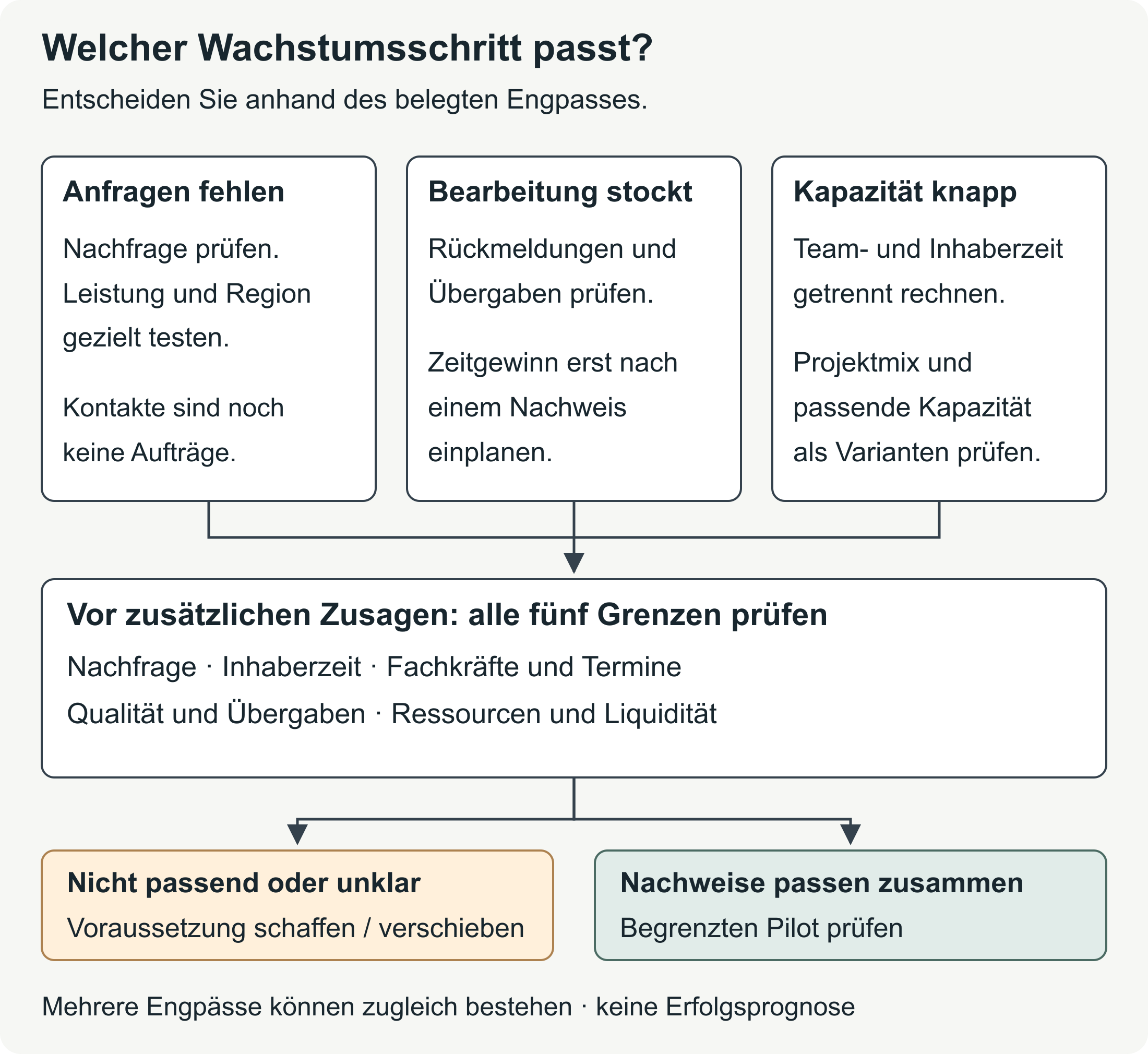
Check each requirement separately
A good figure cannot make up for a missing requirement. Ten suitable enquiries do not provide missing plumbing hours, and free time does not replace qualifications.
| Requirement | What to record for the proposed job |
|---|---|
| Demand | Suitable enquiries by service, area and price range; known reasons jobs did not go ahead |
| Team capacity | Hours available for jobs after deducting other activities and a reserve; existing commitments by trade and week |
| Owner's time | Time available for site visits, quotes and coordination; do not count site hours twice |
| Qualifications | Who has the skills to carry out the work and is available on the required dates |
| Quality and handovers | Agreed scope, named people responsible and the acceptance process |
| Materials and liquidity | Availability of the equipment needed and funds to cover payments when due |
For team hours, a plan by trade helps: each area of skilled work involved needs its own allocation. Someone with time to spare cannot replace the missing tradesperson if their qualifications or availability do not fit. In a small business, the owner may also work on site. Those hours must not then appear again as free time for site visits and management. [b]
Liquidity means being able to make payments when they fall due. A job that looks profitable on paper can incur expenses before the customer pays. [7] The WKO recommends monthly liquidity planning for this. [5] The job costing, including the owner's pay, still needs a separate check. [1]
For the two small projects, record the expected payment date alongside each materials requirement. Also note when the customer is expected to pay. This view of timing supplements the job costing. Before committing, check whether available funds and expected receipts will cover expenses when they fall due. [5]
For checking prices, the WKO price calculator for one-person businesses and SMEs offers guidance that takes costs and the owner's pay into account. [6] Use the same definition of costs when comparing project options. [b]
The detailed checklist and costing aids help you add evidence for each unresolved point.
Compare two job options in the same hours plan
In the fictional bathroom renovation business, three skilled tradespeople are planning for four weeks. After known absences, each has 32 hours available per week. This gives 3 × 32 × 4 = 384 person-hours. Deduct 60 person-hours for activities unrelated to specific jobs and 24 person-hours of uncommitted reserve. This leaves 300 person-hours of capacity for jobs. Of these, 252 are already committed; the time still available to allocate is 48 person-hours. These figures are neither industry figures nor a statutory working-time requirement. [a]
The owner's coordination time is calculated independently of these three tradespeople: of 24 available hours, 20 are committed, leaving four.
The options are two small projects requiring 20 person-hours and 1.5 coordination hours each, or one complete bathroom renovation requiring 72 person-hours and six coordination hours. These are alternatives within the same period and must not be added together.
| Additional option | Total team hours | Total coordination hours |
|---|---|---|
| Two small projects | 252 + 40 = 292 of 300 person-hours | 20 + 2 × 1.5 = 23 of 24 hours |
| One bathroom renovation | 252 + 72 = 324 of 300 person-hours | 20 + 6 = 26 of 24 hours |
The small projects pass both hours checks. However, eight remaining team hours and one coordination hour are not a general recommendation to plan for such a high workload.
The additional bathroom leaves a shortfall of 24 team hours. In the model, a suitable partner could provide 24 confirmed person-hours at the required times. That would cover 324 team hours; the internal reserve would remain uncommitted. But the owner would still be short of two coordination hours. The bathroom therefore remains unapproved. [a]
Assuming better office organisation does not create free hours either. In the full model, twelve of the 60 person-hours unrelated to specific jobs become available only once the saving has been demonstrated. Capacity for jobs would then be 312; the bathroom renovation, with a total requirement of 324 person-hours, would still leave a shortfall of twelve. This efficiency assumption and the partner option are independent alternatives starting from 300 person-hours. They are not added together. [a]
Person-hours also do not tell you how long a project will occupy the calendar. The sequence of work and delivery dates must fit. The full hours model shows further independent options and explains when a demonstrated time saving can be included in the plan.
Use the findings to design a small test
In this example, it makes sense to assess the two small projects for the next four-week planning period. The trial should establish whether this scope is viable under the actual conditions. The hours calculation alone establishes neither demand nor profitability. [a]
To check demand, first review which existing enquiries fit these smaller jobs and the service area. Keep an unresolved enquiry clearly marked as such. Record a quote already sent and a confirmed job separately. Their respective status shows what is actually evidenced. In the sample, suitable demand has not yet been confirmed as a starting condition. [b]
Before making a commitment, the owner checks the unresolved requirements in the table. The team lead records hours and handovers. The planning figures are 292 of 300 person-hours and 23 of 24 coordination hours. For your own business, replace every sample figure with a checked value.
The handover must also be clear before work starts. A site measurement records the dimensions at the property. It should be clear who confirms them and incorporates approved changes. Someone must also be responsible for acceptance of the work. Weekly comparisons can then link rework and unplanned coordination to what actually happened. [b]
At the end of each pilot week, compare planned hours and costs with the actual figures. Also record whether enquiries matched the agreed scope and where handovers led to rework. Make no further commitments if the hours plan has been exceeded, a quality issue remains unresolved or a payment cannot be covered. Jobs already promised remain separate obligations and need to be handled separately. After the trial, decide whether to expand, change or end it. [b]
If the trial does not confirm a requirement, record the cause. The scope may need to be smaller, or a handover may need improving first. A larger budget alone is no reason to repeat the same weak test unchanged. Ending it is also an option. [b]
Copy the full test brief for a real proposal. Enter the person responsible and the review date. State explicitly which requirement is confirmed and which one the trial still needs to establish.
Use your website to address the findings
If capacity is available but suitable demand is missing, the website needs a clear description of the chosen service and the actual service area. If existing enquiries are getting held up instead, the website enquiry process helps with the next step. The regional market analysis helps put regional search data in context. Search interest and confirmed jobs remain different signals. [b]
A traceable record from initial contact through the quote to the decision helps with this analysis. A customer management system, often called a CRM, can hold this information. Record the reasons jobs did not go ahead there too: an unavailable date calls for a different response from an unsuitable location. General search figures for Austria do not, on their own, show demand for bathroom renovations in your service area. [b]
BrandHoop works on websites and SEO and provides technical support for them. This supplementary guide offers a planning aid. Start with the unresolved requirement for your proposed job and record how you will check it in the test brief.
Editorial version dated 16 October 2026. Numbers link to sources; letters explain editorial examples or recommendations. Each source note states what the source supports.
[b] Practical recommendations. The suggested processes and decision aids are editorial applications of the principles cited. Their specific effect on enquiries or jobs has not been measured here.
[a] Editorial examples. Content labelled as a sample or fictional illustrates possible situations. It does not describe real client cases or provide evidence of a measured effect.
Sources and context (7 sources)
- Kalkulation und Wirtschaftlichkeit — Wirtschaftskammer Österreich
The calculation separates revenue, variable costs, staffing and other fixed costs, as well as contribution margin and operating profit. Further sections cover bottlenecks, billable hours and the owner's pay. This older brochure is used solely for its terminology and planning structure. Its example figures for non-wage labour costs and the owner's pay are not used as current figures. The five constraints, the contribution per bottleneck hour and all the hours in the example are planning aids developed for this article, not WKO statistics or confirmation of profitability. Checked: 2026-10-16.
- Inhalte des Businessplanes — Wirtschaftskammer Österreich
The WKO describes the structure of a start-up business plan: products and services, market and competition, marketing, the business and its management, profit and financial planning, and implementation. Applying this overview to a growth step in an existing trades business is a practical suggestion made by this article. The source does not confirm any particular project return or demand, or validate the five-part decision matrix as a model. Checked: 2026-10-16.
- Understanding Firm Growth: How do scalers contribute to economic growth? — OECD Publishing
The OECD report distinguishes expansion of an existing business from growth through acquiring other businesses. Only this distinction in terminology is used. No growth, employment or success rate from the report is applied to the fictional Austrian trades business. The source provides neither a financing rule nor an assessment of an individual acquisition here. Checked: 2026-10-16.
- Product–market growth strategies: authorised reproduction of Ansoff's matrix, Figure 1.4 — John Wiley & Sons; original figure by H. Igor Ansoff, Harvard Business Review, September–October 1957
The freely accessible publisher's extract shows the original figure reproduced with permission from Harvard Business Review. It confirms the combinations of existing or new products and services and markets. The bathroom renovation cases are fictional illustrations developed for this article; the model establishes neither regional demand nor an increase in growth or profit. The figure also uses the terms Expansion, Related Diversification and Unrelated Diversification. The article uses the usual English equivalents of the German names for the growth directions and explains their respective combinations. The original full HBR article was not read. Checked: 2026-10-16.
- Liquiditätsplanung und Liquiditätssicherung — Wirtschaftskammer Österreich
The WKO recommends monthly liquidity planning and an overview of reserves, liabilities and the timing of receipts and payments. This is a planning aid, not an assessment of ability to pay or confirmation of an individual commitment. The fictional time reserve of 24 person-hours is entirely separate and is not a financial reserve ratio. Historical crisis measures and detailed legal guidance on the page are not carried over. Checked: 2026-10-16.
- Preisrechner für EPU & KMU — Wirtschaftskammer Österreich
The official description offers pricing guidance that takes costs and the owner's pay into account. No data was entered into the linked calculator and no specific price was calculated. It does not establish a profit or replace an assessment of a job. Checked: 2026-10-16.
- Kapitalbedarf (capital requirements) — Wirtschaftskammer Österreich
The source identifies long-term capital requirements for fixed assets such as vehicles and machinery, and short-term requirements for materials and payments not yet received. This article applies that distinction to planning a growth step. It neither adopts the page's general reserve recommendation nor treats it as evidence that a business has sufficient liquidity. Checked: 2026-10-16.