Full version with all templates and detailed checks. Back to the main article
Growth strategy for small trades businesses: plan jobs and capacity together
An extra job can fit your services well and still fall through because the calendar is full. Or your business may have time to spare but too few suitable enquiries. A growth strategy therefore starts by asking what is currently limiting the next step. That limit is the bottleneck.
The answer determines whether your business needs more demand, should handle incoming enquiries better or must first create capacity. In its revenue planning, the WKO also considers bottlenecks in sales, staffing and production. [1] Strong demand alone does not make skilled tradespeople available.
The tables below connect these considerations with an hours plan. All figures and bathroom renovation projects are fictional. BrandHoop provides this guide as supplementary working material; it does not describe its own client cases or promise business success.
What is a growth strategy?
A growth strategy describes how your business should develop: which services you want to offer to which customers, and the resources needed. The aim includes a suitable service area and working processes your team can manage. Equipment and financing also need a place in the plan. A similar connection between products and services, the market, organisation and financial planning appears in the WKO guide to the contents of a business plan. [2]
"More revenue" still leaves open what should change in day-to-day work. You may want to take on more suitable jobs in your existing area. An additional service may be an option. Earning more while running the same number of sites in parallel can also be a goal. The calculated project result or keeping to agreed dates makes progress easier to see later; you can also observe whether less unplanned coordination is needed. [b]
Keep known constraints separate from untested assumptions. "There could be demand in this region" is initially a hypothesis: an assumption that still needs evidence. Only with that evidence can you judge whether people, materials or money can be allocated to it.
More work and scalability
More jobs initially mean more work. For planning purposes, scalability asks whether your business can deliver more while the extra effort grows at a slower rate. A repeatable office process could be one approach. Only using it will show whether it actually saves time per job. The skilled tradesperson needed on site still counts in the hours plan. [b]
Organic growth means developing your existing business. Acquiring another business is classed as inorganic growth. The OECD also uses this distinction between expanding an existing business and acquiring other companies. [3] The source of financing alone does not determine the category. An acquisition needs its own assessment and goes beyond the small growth test described here.
Ansoff's four growth directions
Igor Ansoff's model connects two decisions: a business keeps its existing offering or develops a new one, while serving either its existing market or a new one. This gives four growth directions that can also apply to services. The authorised reproduction in Figure 1.4 of the Wiley publisher's extract shows this product–market matrix. [4]
The following ideas for a bathroom renovation business illustrate the four directions. They are fictional. Whether customers want the service and whether it fits your business still need to be established in each case.
Market penetration: existing offering and area
With market penetration, a business sells more of its existing offering in its current market. [4] In the fictional example, this would mean more familiar partial renovations in the same district.
Reviewing previous quotes helps put the next step in context. A job may not have gone ahead because no suitable dates were available. In another case, the scope or price expectations were unclear, or the customer expected something different. These lead to different tasks. Even a familiar service needs further suitable demand and a team able to carry out the work. [b]
Market development: new areas or customers
Market development combines an existing service with a new market. [4] A business could offer its existing work to property managers in a neighbouring area for the first time.
For this fictional step, additional travel time and site visits belong in the costing. The extra coordination also belongs in the plan. Suitable enquiries alone are therefore not enough to decide: the work must be financially viable with the actual journeys involved and fit the calendar.
Product development: new services
With product development, a business expands its offering for a market it already serves. [4] A clearly defined "shower instead of a bath" package would be a fictional addition to the existing offering.
To make this a service you can test, its scope must be clear. This includes the qualifications and equipment needed and how the people involved will work together. Sometimes an idea for an offering comes from defining a service more clearly or organising its delivery better. Whether customers want to pay for it is a separate question for the test.
Diversification: new services in new markets
Diversification changes the offering and the market at the same time. [4] A business would offer a service it has not delivered before to a new customer group. Requirements on both sides therefore remain unresolved.
A limited trial with a qualified partner may be an option once the tasks and skills needed are clear. Keep visible what your business can demonstrate itself and what the partner will handle. Trying several new directions at once would make evaluation harder once results can no longer be attributed separately.
Check five constraints before growing
A combined overview helps when considering a specific growth step. The table below relates to a particular service and target group within a set period. Your own copy has room for the supporting evidence. [b]
Capacity here means the work your team can take on with the time available. Liquidity includes being able to make payments when they fall due. Expected receipts and expenses must therefore also fit together in time. The WKO covers this timing in its liquidity planning. [5]
| Constraint | What to check | Useful evidence | Action if a gap remains |
|---|---|---|---|
| Regional demand | Are there suitable enquiries for the service, area and price range? | Reviewed enquiries, reasons for quotes and jobs not proceeding, a limited market test | Test demand first |
| Owner's time | Do you have enough time for site visits, quotes, coordination and management? | A calendar showing free and already allocated time | Reassign the task or postpone growth |
| Qualified people | Do the tradespeople, hours and dates fit the job? | A plan by trade; partners have confirmed their available hours and dates | Choose a smaller scope or create capacity |
| Quality and handovers | Is it clear which work is included, who is responsible and how acceptance will work? | A checked process and named people responsible | Improve the handover first |
| Resources and liquidity | Will equipment, materials and funds for payments be available when needed? | A procurement plan, costing and liquidity forecast (planned receipts and payments) | Resolve financing or the process first |
These constraints cannot offset one another. Ten suitable enquiries do not provide missing plumbing hours, and free time does not replace qualifications.
The overview leads to three possible decisions: assess a small pilot, put the requirement in place or postpone. A pilot is a small test with a fixed duration. Additional commitments can only be considered once their requirements fit together. An overall score could easily hide such a gap.
Plan your time and the team's hours
In a small business, the same person may do site work and coordination. If your site hours are already included in the tradespeople's plan, those hours are not also available for site visits or management. These types of work therefore need separate time slots in the calendar. The WKO recommends calculating billable owner and employee hours transparently and allowing for non-billable time. [1]
For carrying out the work, the breakdown by trade and week also matters. Trades are the individual areas of skilled work involved in a construction project. Someone with free time can help with a particular step only if their qualifications and availability fit.
Handovers need to be just as specific. A site measurement records the dimensions at the property. The agreed process should specify who confirms them, incorporates approved changes and checks acceptance of the work. Records of rework and unplanned coordination later show where actual effort differed from the plan. A new form must also prove useful in this work. [b]
Whether a job is financially worthwhile
Checking hours does not yet answer whether a job is financially worthwhile. Revenue and costs need a separate calculation, including the owner's pay. The WKO's basic costing template distinguishes planned revenue, variable costs, staffing costs and other fixed costs. Variable costs depend on the quantity delivered or sold; over a shorter period, fixed costs arise regardless of an individual job. [1]
In this calculation, the contribution margin is revenue minus variable costs. It is not yet profit, because further costs are then deducted. [1] The WKO price calculator for one-person businesses and SMEs offers pricing guidance that takes costs and the owner's pay into account. [6] The specific job still needs to be costed before making a commitment.
If hours in a particular trade are scarce, the expected contribution per hour of that trade can help with comparison. Both quotes need the same definition of costs. The result applies under your assumptions; it is not a general industry figure. Existing obligations and the sequence of dates remain part of the decision, as does the quality of the work. [b]
Plan equipment and payments
The WKO guidance on business plan contents connects products and services and the market with organisation, financial planning and the steps towards implementation. [2] This structure can also serve as an overview when an existing business prepares a limited growth step.
In its guidance on Kapitalbedarf (capital requirements) the WKO distinguishes, for example, long-term purchases such as vehicles and machinery from short-term requirements for materials or payments not yet received. [7] A job can therefore incur expenses before the customer pays, even if its costing suggests it would be profitable.
The WKO recommends monthly liquidity planning, showing reserves and liabilities. [5] In your plan, link expected payments to jobs and procurement dates. The business's specific needs are more informative than a reserve ratio adopted without checking.
Fictional hours example: which jobs fit?
All figures and project scopes below are invented. They are not averages for bathroom renovations or statements about demand, prices, profitability or statutory working hours. The planning period is four weeks. [a]
In the model, three skilled tradespeople each have 32 hours per week available after known absences. Time for activities unrelated to specific jobs and the reserve are deducted afterwards:
- Available team time: 3 × 32 × 4 = 384 person-hours.
- Activities unrelated to specific jobs: 60 person-hours.
- Uncommitted reserve for the unexpected: 24 person-hours.
- Capacity that can reliably be allocated to jobs: 384 − 60 − 24 = 300 person-hours.
- Projects already committed: 252 person-hours.
- Still available to allocate: 300 − 252 = 48 person-hours.
Two tradespeople working for five hours at the same time use ten person-hours. That does not yet give the project duration: the sequence of work, other trades and delivery dates can limit the calendar.
Two additional project options to compare separately
The model offers two options for the available time: two smaller projects of 20 person-hours each, or one complete bathroom renovation of 72 person-hours. These are alternatives that must not be added together. [a]
| Option within the same period | Team capacity | Team hours needed | Time remaining or shortfall |
|---|---|---|---|
| Existing commitments with no addition | 300 person-hours | 252 person-hours | 48 remaining |
| Two additional small projects | 300 person-hours | 252 + 40 = 292 person-hours | 8 remaining |
| One additional bathroom renovation | 300 person-hours | 252 + 72 = 324 person-hours | 24 short |
| Bathroom plus demonstrated efficiency | 312 person-hours | 324 person-hours | 12 short |
| Bathroom plus confirmed partner | 324 person-hours | 324 person-hours | 0 remaining |
The initial workload is 252 ÷ 300 × 100 = 84 %. With the two small projects, it is 292 ÷ 300 × 100 ≈ 97.3 %. In each case, the denominator is the 300 person-hours of capacity available for jobs. The 24 reserve hours are already excluded. These figures are neither target utilisation nor an industry benchmark, so they are not a basis for comparison with other businesses. [a]
The last two rows of the table are also independent alternatives starting from a base of 300 person-hours. In the efficiency hypothesis, 12 of the 60 hours unrelated to specific jobs actually become available. Capacity rises to 312 only once this saving has been demonstrated; until then, the planning base stays at 300. Even after the saving is demonstrated, the additional bathroom is twelve hours short.
In the partner scenario, a suitable external tradesperson provides 24 person-hours that fit the work and schedule, under a confirmed agreement. This gives 300 + 24 = 324. The scenario includes no additional time saving. The internal reserve of 24 remains uncommitted. [a]
Calculate the owner's coordination time separately
For the same period, the model provides 24 hours of the owner's time for coordination, independently of the three tradespeople. Of these, 20 are already committed, leaving 24 − 20 = 4 hours. The additional bathroom needs six hours; each small project needs 1.5 hours. [a]
| Option | Coordination hours needed | Comparison with 24 available hours |
|---|---|---|
| Existing projects | 20 hours | 4 remaining |
| Two additional small projects | 20 + 2 × 1.5 = 23 hours | 1 remaining |
| One additional bathroom renovation | 20 + 6 = 26 hours | 2 short |
The bathroom therefore remains unapproved even in the partner scenario. The team bottleneck has been resolved on paper, but the 26 coordination hours needed exceed the owner's 24 available hours. [a]
The two small projects pass both hours checks and are therefore possible on paper. Eight remaining team hours and one remaining coordination hour are not a general recommendation to plan for such a high workload.
More enquiries, better handling or a different project mix?
The hours example shows why the next step depends on the bottleneck. A business with available tradespeople faces a different decision from one whose owner's time is already fully committed. Keep the service, region and planning period the same for a comparison. [b]
| Approach | Relevant starting finding | What to check | Constraint before additional commitments |
|---|---|---|---|
| Attract more suitable enquiries | Capacity and the necessary conditions are in place; actual demand remains uncertain | Check demand in a limited test; assess suitable contacts by service and area | More contacts do not make skilled tradespeople available or jobs financially worthwhile |
| Handle existing enquiries better | Suitable enquiries arrive, but replies, quotes or handovers stall | Check which enquiries have been left waiting, who is responsible and what needs to happen next | Only include time savings or additional confirmed jobs in the plan once you have actually observed them |
| Change the project mix | There is interest, but a particular trade or the owner's time limits commitments | Compare options using the same definitions of costs and hours | Small projects also need suitable demand and dates. Quality and the ability to pay must be in place too |
Several bottlenecks can exist at once.
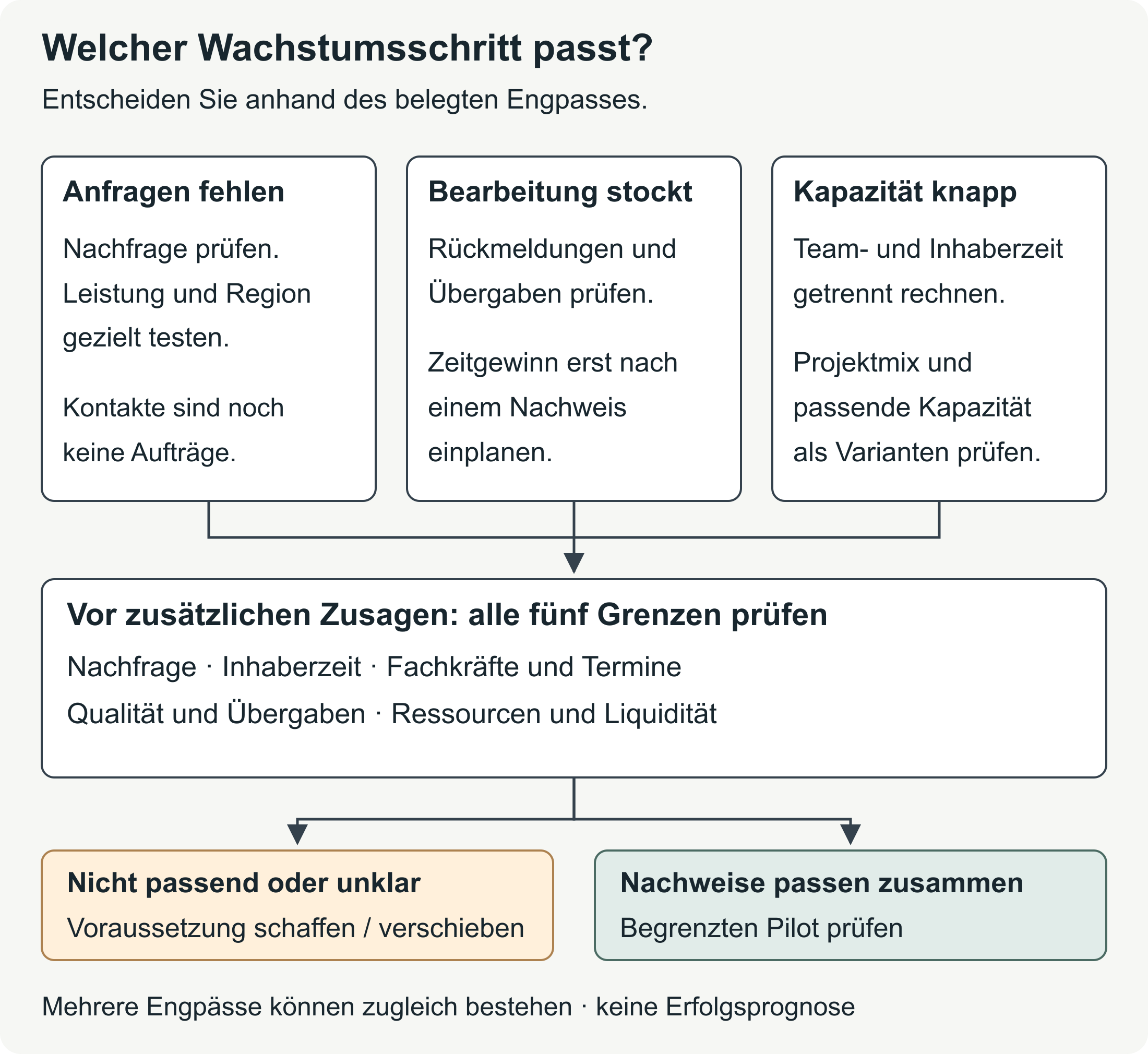
Start a small test
A pilot starts with the unresolved question. If demand is uncertain, a limited demand test may be suitable. If skilled working hours are missing, first establish who is available on the required dates.
The starting assessment records which services the business offers, where it works and what is already committed. It also includes the business's strengths and weaknesses. This allows a hypothesis to be formulated for a precisely defined service and customer group. When the five constraints are then checked, confirmed evidence stays distinct from assumptions and unresolved points. [b]
Give the test a fixed scope, a period and a person responsible. Before it starts, also set the conditions for continuing or stopping it. Afterwards, compare planned hours and costs with the actual figures; the review also covers handovers and demand. Use this as the basis for deciding whether to expand, change or end the trial.
A negative result can also show which requirement is missing. Recording the cause helps with the next decision. A larger budget alone does not justify repeating the same weak test unchanged.
Copy a sample test brief
The test brief below is entirely fictional and can be copied as a template. For your own business, replace the assumptions with checked values. [a]
| Field | Fictional test brief |
|---|---|
| Decision | Assess two small projects for the next four-week planning period |
| Responsibility | Owner for approval; team lead for hours and handovers |
| Evidence of demand | Check suitable enquiries by service and area; do not treat demand as already established |
| Evidence of capacity | Team plan: 292 of 300 person-hours; coordination plan: 23 of 24 hours; also check qualifications and the calendar |
| Financial evidence | Check job costing and monthly payment planning before committing |
| Review date | Approve before committing; compare the plan with actual results at the end of each pilot week |
| Rule for continuing | Only commit to further projects after checking all five constraints and recording the result |
| Rule for stopping | Make no further commitments if the hours plan is exceeded, a quality issue remains unresolved or a payment cannot be covered |
If a stopping rule applies, limit new commitments and correct the plan in good time. Jobs already promised need to be handled separately. They remain part of the business's obligations.
Your website, enquiries and demand
The chosen service and region also give marketing a specific focus. The website can explain which work is included, which requirements apply and where your business operates. This informs the choice of suitable channels. The website enquiry process covers the handling of incoming enquiries. The regional market analysis helps put regional data in context. [b]
A customer management system, often called a CRM, can record enquiries and quotes through to a decision. The reasons jobs did not go ahead are useful for analysis too. A lack of demand is different from a suitable enquiry that did not become a job because of timing, price, area or scope. A business with such enquiries and too little time therefore needs a different next step from one that cannot yet demonstrate suitable demand.
Regional search data can supplement the market assessment. But the general search frequency of the term "Wachstumsstrategie" (growth strategy) in Austria does not tell you how many people want to buy a bathroom renovation in your service area. Search interest, suitable enquiries and confirmed jobs remain separate signals. [b]
Your next step
A specific proposed job gives the planning a manageable scope. It shows how the extra work affects the calendar. The tables record what is already evidenced and which question a small test still needs to answer. [b]
Sources and assessment aids
The linked Ansoff matrix helps put the direction of the offering and market in context. For your own planning, the WKO documents complement one another: the costing template covers revenue and costs, while the guidance on capital requirements and liquidity covers available funds and payment timing. The table of five constraints and the test brief can be used alongside them as worksheets.
All figures and projects in the hours model remain fictional. For decisions in your own business, replace them with actual commitments, confirmed schedules and your own costing.
Editorial version dated 16 October 2026. Numbers link to sources; letters explain editorial examples or recommendations. Each source note states what the source supports.
[b] Practical recommendations. The suggested processes and decision aids are editorial applications of the principles cited. Their specific effect on enquiries or jobs has not been measured here.
[a] Editorial examples. Content labelled as a sample or fictional illustrates possible situations. It does not describe real client cases or provide evidence of a measured effect.
Sources and context (7 sources)
- Kalkulation und Wirtschaftlichkeit — Wirtschaftskammer Österreich
The calculation separates revenue, variable costs, staffing and other fixed costs, as well as contribution margin and operating profit. Further sections cover bottlenecks, billable hours and the owner's pay. This older brochure is used solely for its terminology and planning structure. Its example figures for non-wage labour costs and the owner's pay are not used as current figures. The five constraints, the contribution per bottleneck hour and all the hours in the example are planning aids developed for this article, not WKO statistics or confirmation of profitability. Checked: 2026-10-16.
- Inhalte des Businessplanes — Wirtschaftskammer Österreich
The WKO describes the structure of a start-up business plan: products and services, market and competition, marketing, the business and its management, profit and financial planning, and implementation. Applying this overview to a growth step in an existing trades business is a practical suggestion made by this article. The source does not confirm any particular project return or demand, or validate the five-part decision matrix as a model. Checked: 2026-10-16.
- Understanding Firm Growth: How do scalers contribute to economic growth? — OECD Publishing
The OECD report distinguishes expansion of an existing business from growth through acquiring other businesses. Only this distinction in terminology is used. No growth, employment or success rate from the report is applied to the fictional Austrian trades business. The source provides neither a financing rule nor an assessment of an individual acquisition here. Checked: 2026-10-16.
- Product–market growth strategies: authorised reproduction of Ansoff's matrix, Figure 1.4 — John Wiley & Sons; original figure by H. Igor Ansoff, Harvard Business Review, September–October 1957
The freely accessible publisher's extract shows the original figure reproduced with permission from Harvard Business Review. It confirms the combinations of existing or new products and services and markets. The bathroom renovation cases are fictional illustrations developed for this article; the model establishes neither regional demand nor an increase in growth or profit. The figure also uses the terms Expansion, Related Diversification and Unrelated Diversification. The article uses the usual English equivalents of the German names for the growth directions and explains their respective combinations. The original full HBR article was not read. Checked: 2026-10-16.
- Liquiditätsplanung und Liquiditätssicherung — Wirtschaftskammer Österreich
The WKO recommends monthly liquidity planning and an overview of reserves, liabilities and the timing of receipts and payments. This is a planning aid, not an assessment of ability to pay or confirmation of an individual commitment. The fictional time reserve of 24 person-hours is entirely separate and is not a financial reserve ratio. Historical crisis measures and detailed legal guidance on the page are not carried over. Checked: 2026-10-16.
- Preisrechner für EPU & KMU — Wirtschaftskammer Österreich
The official description offers pricing guidance that takes costs and the owner's pay into account. No data was entered into the linked calculator and no specific price was calculated. It does not establish a profit or replace an assessment of a job. Checked: 2026-10-16.
- Kapitalbedarf (capital requirements) — Wirtschaftskammer Österreich
The source identifies long-term capital requirements for fixed assets such as vehicles and machinery, and short-term requirements for materials and payments not yet received. This article applies that distinction to planning a growth step. It neither adopts the page's general reserve recommendation nor treats it as evidence that a business has sufficient liquidity. Checked: 2026-10-16.