Full version with all templates and detailed checks. Back to the main article
Writing a payment reminder: Friendly templates for Austria
Here are three complete samples for your first friendly payment reminder in Austria: an email, a letter and a message following a part payment. Before sending, reconcile the invoice against actual payments and agreements. The message mentions only the amount that remains outstanding and due after these checks.
A friendly payment reminder identifies the invoice, explains the outstanding amount and leaves room for a reply. The WKO also describes it as a polite notice about an outstanding payment. [1] Assuming the customer has deliberately ignored the invoice will not help resolve the matter. [b]
The worked calculation shows how to enter the remaining amount in the appropriate template. A specific dispute about the invoice needs to be resolved separately.
Before sending: Check payments
An outstanding item initially means an invoice amount that your records show as unpaid. Whether the customer still owes it can only be assessed alongside the related transactions and records. Payments already received and any credit notes therefore belong with the invoice. Otherwise, a transfer without the matching invoice number can easily be overlooked. [b]
Start with the original invoice: which work was invoiced, who received it and whether the agreed recipient address is correct. Also check when payment is due, meaning the date by which it must be made. This is generally governed by the contractual agreement; without such an agreement, payment is generally due once the corresponding work has been performed. This is explained in the USP guide to contract law. The invoice date alone therefore does not establish when payment is due. [2]
The agreed date may appear in the quotation and order. Later agreements count too, for example if you have agreed a payment plan. For a bathroom renovation, you also need to distinguish an agreed interim invoice from the final invoice. The total value of the job is not automatically the amount currently in question. [b]
Subtract the allocated part payments, credit notes and agreed deductions from the invoice amount to find what remains outstanding. This remainder is also called the balance. Entering a sum in a template does not resolve a customer's complaint or missing invoice information. Address these questions before the first request for payment. [b]
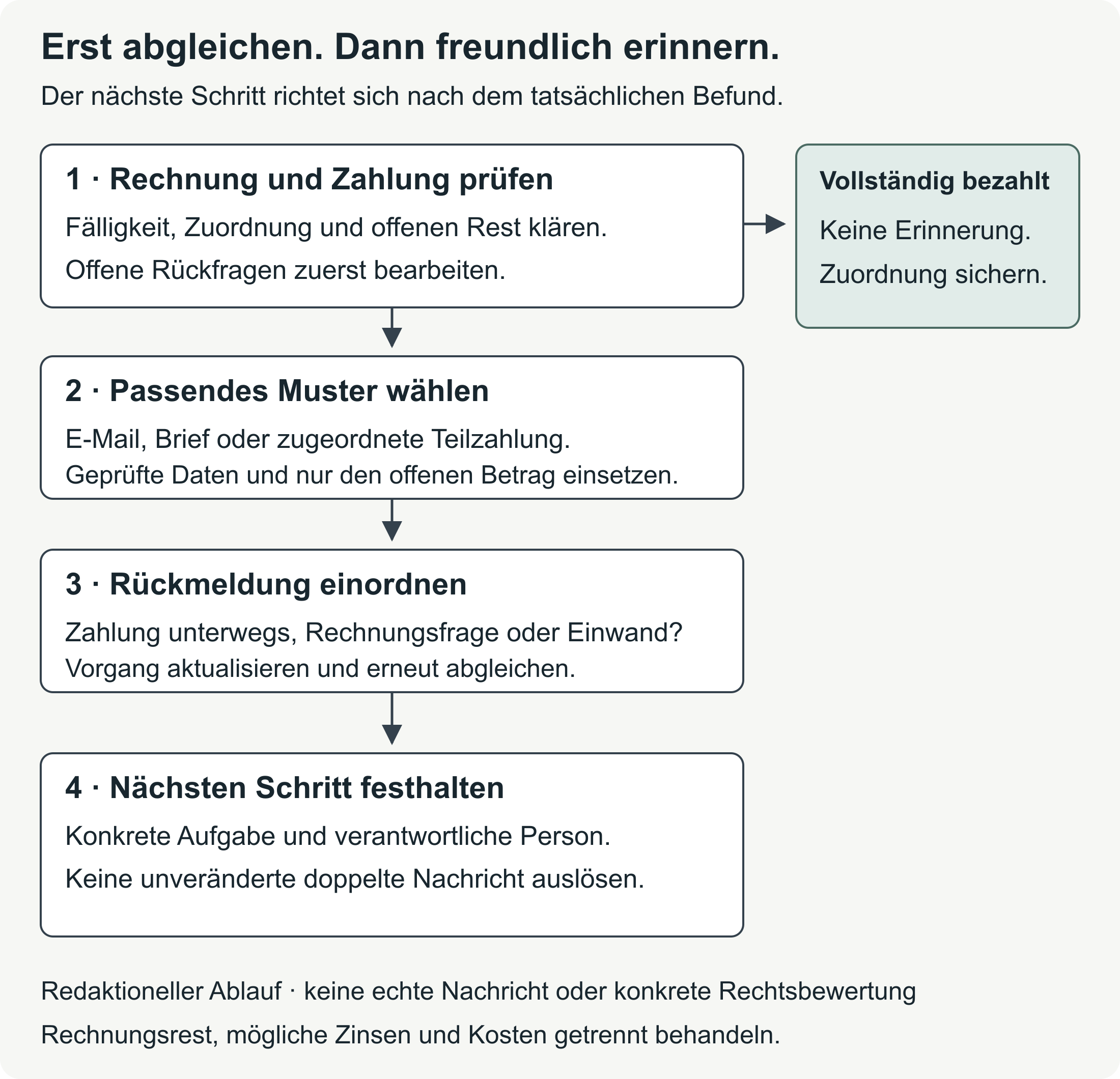
The following overview helps you choose the next step. It assumes an actual reconciliation has taken place; whether a claim is legally justified in a particular case still needs to be assessed separately. [b]
| Result of your checks | Appropriate next step |
|---|---|
| The amount has been paid in full and allocated to the invoice. | Send no payment reminder; correct the outstanding entry. |
| A part payment has been allocated and, according to your checks, the balance is due. | Mention only the outstanding balance; use template 3. |
| The invoice and due date have been clarified, and no payment can be identified. | Use template 1 or 2 to ask politely for payment or a reply. |
| The customer has announced a transfer, you cannot allocate a payment or a question about the invoice remains unresolved. | First clarify the date, amount or unresolved question. Then check again. |
A short note in the record shows which payment status the reminder refers to. Include the reconciliation date and the person handling the matter. If a reply arrives later, others in the business can also see what was known before the message was sent. [b]
Payment reminder or payment demand?
For the first letter, the checked payment status and due date matter. Whether your customer is acting as a consumer is also relevant. The samples leave room for clarification. [b]
The heading “Payment reminder” often describes only the friendly tone. Even a polite request for payment can legally constitute a payment demand (Mahnung): under the OGH legal principle, the demand for performance must be recognisable; no particular form is prescribed. The content and circumstances determine this. [3]
Default in payment requires the contractor to have performed in accordance with the contract and the applicable payment date to have been missed. The age of the invoice alone proves neither. This is explained in the late payment FAQs published by the WKO. [4]
If the due date can be determined from an agreement, the law or the nature of the work, a demand is generally not needed for default to arise. Otherwise, the creditor must make performance due by issuing a demand. This distinction is explained in the WKO guide to default in performance and acceptance. [5]
There is no general obligation to send three payment demands. Where payment is due and the customer is in default, the WKO does not list a prior demand as a requirement for bringing the claim to court. [4]
Consumer or business customer?
For a privately commissioned bathroom, your customer may be acting as a consumer. If the job forms part of their business operations, it is classified differently. Under § 1 KSchG, the particular transaction determines this; the customer's occupation alone is not enough. [6]
Alongside the ABGB, contracts between businesses require particular attention to the rules of the UGB; transactions between businesses and consumers are subject, among other provisions, to the KSchG. This legal framework is explained in the USP guide to contract law. [2]
If a consumer pays a monetary debt to a business by bank transfer, § 6a(2) KSchG provides that instructing the transfer on the due date is enough for payment to be on time, even where the date was set in advance. The absence of an incoming payment in the bank account therefore does not, by itself, prove late payment. [7]
Default interest concerns late payments; recovery costs concern collecting the debt. For these claims, the WKO distinguishes between business and consumer transactions. [4] Reimbursement under § 1333(2) ABGB requires the creditor to have suffered a loss caused by the debtor's fault. Out-of-court recovery costs must be necessary and appropriate, and proportionate to the claim. [8]
The templates state only the checked invoice balance, without reminder fees or default interest. Interest or costs would be separate items requiring their own basis. Sending a reminder alone does not justify an arbitrary extra amount. [b]
What to include in the message
According to the WKO FAQs, a payment demand does not have to take any particular form. [4] A message that can be matched clearly to an invoice still needs specific details. The customer should be able to identify the invoice concerned and the payment status on which your request is based. The following list is a writing aid. [b]
- A clear subject line with the invoice number.
- The invoice date and checked outstanding amount in EUR.
- The originally agreed due date.
- The date you reconciled the payments.
- A polite request for a transfer or clarification.
- Contact details for invoice queries.
- An acknowledgement that the customer may already have instructed payment.
The wording “Our reconciliation shows that an amount is still outstanding” stays within what you actually know. It also leaves open the possibility that a transfer is on its way or has been allocated incorrectly. The contact details give the customer a clear route back to your business with any invoice question. [b]
The samples retain the originally agreed due date. They do not set a general new deadline for payment or a reply. If you want to give an additional date, it must suit the particular matter. [b]
Three payment reminders to copy
The email and letter concern an invoice to which payment of the outstanding amount has not yet been allocated in full. The third sample also states the part payment already allocated. All texts are samples with placeholders in square brackets. Fill every field with your actual details before sending. [b]
You can enclose the original invoice again. Refer to an attachment only if you actually send the file or document with the message. The figures and dates in the later calculation are entirely fictional.
| Field in the sample | Meaning and use |
|---|---|
| [Salutation] | An appropriate salutation, such as “Dear Ms Muster,”; remove the brackets before sending. |
| [Invoice number] | The number exactly as it appears on the original invoice. |
| [Invoice date] | The date the invoice was issued. |
| [Outstanding amount] | The checked amount still outstanding in EUR, which may be only the balance. |
| [Agreed due date] | The originally agreed payment date; do not invent a deadline. |
| [Reconciliation date] | The day you checked your bank account and accounting records. |
| [Contact details] | Your appropriate email address or telephone number for queries. |
| [Name and business] | The name of the person responsible and the name of your business. |
| [Sender's address] and [Recipient's address] | The checked postal addresses for the letter. |
| [Place and letter date] | The place and date on which you prepare the letter. |
| [Original invoice amount] | The total amount of the invoice concerned before the payments mentioned here. |
| [Allocated part payment] | The payment amount already allocated to this invoice. |
| [Remaining balance] | The amount remaining after the full reconciliation. |
Template 1: Email
Subject: Payment reminder for invoice [Invoice number] dated [Invoice date]
[Salutation]
On [Reconciliation date], we checked the payments for invoice [Invoice number] dated [Invoice date]. We have not yet been able to allocate the full amount to this invoice. According to our records, [Outstanding amount] EUR remains unpaid. The originally agreed payment date was [Agreed due date].
If the amount is still outstanding, please transfer it to the bank account shown on the invoice. Please use the invoice number as the payment reference.
If you have already instructed the payment, please send us a brief message with the transfer date, amount and payment reference. We will then check the allocation again. Once the payment has been allocated in full, this reminder can be considered resolved.
If any information is missing or you have a question about the invoice, please contact us at [Contact details]. Thank you for your help.
Kind regards
[Name and business]
Template 2: Letter
[Name and business]
[Sender's address]
To: [Recipient's address]
[Place and letter date]
Payment reminder: Invoice [Invoice number] dated [Invoice date]
[Salutation]
This is a friendly reminder about our invoice [Invoice number] dated [Invoice date]. Our reconciliation on [Reconciliation date] shows that [Outstanding amount] EUR remains unpaid. The originally agreed payment date was [Agreed due date].
Please transfer the outstanding amount to the bank account shown on the invoice. Include the invoice number so that we can allocate the payment.
If you have already paid, please send us a brief message with the transfer date, amount and payment reference. We will then check again whether we can allocate the payment to this invoice. Once it has been allocated in full, this reminder can be considered resolved.
If anything about the invoice is unclear, you can reach us at [Contact details]. We will be happy to help with your query.
Kind regards
[Name and business]
Template 3: Part payment
Subject: Outstanding balance on invoice [Invoice number] dated [Invoice date]
[Salutation]
Thank you for your payment. We have allocated a part payment of [Allocated part payment] EUR to invoice [Invoice number] dated [Invoice date], which originally totalled [Original invoice amount] EUR.
Following our checks on [Reconciliation date], [Remaining balance] EUR is still outstanding. The originally agreed payment date was [Agreed due date].
If you have not yet paid the balance, please transfer it to the bank account shown on the invoice. Please use the invoice number as the payment reference.
If you have since instructed another payment, please let us know the transfer date, amount and payment reference. We will check the allocation and update the outstanding entry. If you have any questions or a different agreement applies, please contact us at [Contact details].
Kind regards
[Name and business]
Fictional example: Calculate the balance
In this fictional example, a trades business has invoiced an individual item of work as part of a bathroom renovation. The invoice number is RE-MUSTER-2026-015. The amount is used solely for the calculation and is not a recommended price for a bathroom renovation. [a]
- Invoice date: 15.09.2026.
- Invoice amount: 1,200.00 EUR.
- Expressly agreed due date: 29.09.2026.
- Allocated part payment: 400.00 EUR, recorded on 28.09.2026.
- Reconciliation date: 05.10.2026; no further payment or credit note identified.
1,200.00 EUR − 400.00 EUR = 800.00 EUR outstanding balance. [a]
Template 3 has separate fields for these figures. Enter 1,200.00 under [Original invoice amount], 400.00 under [Allocated part payment] and 800.00 under [Remaining balance]. Add invoice RE-MUSTER-2026-015 dated 15.09.2026 and the agreed due date of 29.09.2026. The message will then also show that part of the amount has already been paid. [a]
The payment date in this example was expressly agreed. The interval between the invoice date and due date is not a general statutory payment period. A further payment after reconciliation would change the balance again. If it had been paid in full and allocated before sending, no reminder would be needed. [a]
Email or letter: What happens next
For the first reminder, use the communication method you have already agreed with the customer. With an email, you can attach the invoice and the customer can reply directly. A letter may suit a customer you have been communicating with by post. Both methods require the correct recipient address. [b]
Sending and receipt are two separate events. A saved email or copy of the letter records what you sent; it does not, by itself, prove receipt by the customer. For payment demands where receipt needs to be provable, the WKO recommends a registered letter for evidential purposes. [4]
Keep the text sent and the documents actually enclosed with the record, together with the recipient and sending date. Managing outstanding payments is called the dunning process (Mahnwesen). A simple status can show whether a query is outstanding or a payment has already been allocated. You can also record who will send the next reply. [b]
A reply may change the situation: a transfer is on its way, a detail is missing or the customer is complaining about the work. Base further contact on this new information. An updated record lets other staff see what has already been clarified before anyone writes to the same customer again. [b]
If the invoice remains unpaid after clarification, the next step requires a separate decision. The “Customer not paying” guide covers what follows. This writing aid ends with a first message that can be clearly matched to the invoice and an appropriate response to a reply.
Sources and checking aids
The Austrian sources explain the legal terms and requirements. For the first message, the payment date actually agreed and the current payment status matter most. The templates and the process shown in the figure are practical aids; the invoice example remains fictional.
- WKO: Zahlungsverzug – FAQs · Due dates, payment demands and differing rules on costs.
- WKO: Leistungs- und Annahmeverzug · Determinable due dates and payment demands.
- USP: Vertragsrecht · The roles of the ABGB, UGB and KSchG.
- RIS: § 6a KSchG · Timely bank transfers for a consumer's monetary debt.
- RIS: § 1333 ABGB · Statutory interest and further damages.
Sources as checked for the previous version on 16.10.2026; editorially revised on 17.10.2026. Numbers link to sources; letters explain editorial examples or recommendations. Each source note states what the source supports.
[b] Practical recommendations. The suggested steps and decision aids are editorial applications of the principles cited. Their specific effect on enquiries or orders has not been measured here.
[a] Editorial examples. Content labelled as a sample or fictional illustrates possible situations. It does not describe real client cases or provide evidence of a measured effect.
Sources and context (8 sources)
- Vorlage Zahlungserinnerung — Wirtschaftskammer Österreich (WKO)
Describes a payment reminder as a friendly notice about unpaid invoices and gives possible reasons for payments not arriving. The three letters used here are our own samples; the WKO has neither reviewed them nor confirmed their effectiveness. The period recommended in the WKO form is not presented here as a statutory deadline. Checked: 2026-10-16.
- Vertragsrecht — Unternehmensserviceportal Österreich; content provided by the Federal Ministry of Justice
Supports the legal framework under the ABGB, UGB and KSchG and the general importance of contractual agreements in determining when payment is due. The wording about the invoice alone explains this principle without assessing any contract. The interest rates and other procedural rules also mentioned on the USP are not included in the templates. Checked: 2026-10-16.
- OGH-Rechtssatz RS0017614: Form und Erkennbarkeit einer Mahnung — RIS / Oberster Gerichtshof
The legal principle explains that no particular form is required and that the demand for performance must be recognisable. Classifying an invoice requires consideration of the circumstances of the case. Applying this to a polite request for payment explains the general test without assessing a letter that was actually sent. Checked: 2026-10-16.
- Zahlungsverzug des Geschäftspartners – FAQs — Wirtschaftskammer Österreich (WKO)
Supports the conditions for default in payment, the absence of a general requirement to send a payment demand before suing for an unpaid claim that is due, the lack of a prescribed form and the different rules on interest and costs. The WKO recommends a registered letter for evidential purposes; this is not a general requirement as to form. No flat fees, interest rates or fixed escalation sequence are included in the templates. Checked: 2026-10-16.
- Leistungs- und Annahmeverzug — Wirtschaftskammer Österreich (WKO)
Distinguishes a due date that can be determined from an agreement, the law or the nature of the matter from cases in which a demand is required to make performance due. This general information does not replace an assessment of a particular invoice or complaint; rules on withdrawal from a contract are not covered here. Checked: 2026-10-16.
- Konsumentenschutzgesetz § 1: Geltungsbereich — RIS / Austrian Federal Chancellery
Section 1(1) ties a person's status as a business or consumer to whether the particular transaction forms part of their business operations. The privately commissioned bathroom is a conditional illustration of that distinction, rather than a determination about a real job. Checked: 2026-10-16.
- Konsumentenschutzgesetz § 6a: Erfüllung einer Geldschuld — RIS / Austrian Federal Chancellery
Subsection 2 establishes that, for a monetary debt owed by a consumer to a business and paid by bank transfer, instructing the transfer on the due date is enough for payment to be on time, even where the due date was set in advance. This is not a general B2B rule and establishes neither the actual execution nor the receipt of any particular payment. Checked: 2026-10-16.
- Allgemeines bürgerliches Gesetzbuch § 1333: Gesetzliche Zinsen und weitere Schäden — RIS / Austrian Federal Chancellery
Subsection 2 requires fault on the debtor's part and loss actually incurred for further damages, as well as necessary, appropriate and proportionate out-of-court recovery costs. It is not a complete account of special UGB rules or contractual agreements and provides no basis for automatic fees in the samples. Checked: 2026-10-16.