Full version with all templates and detailed checks. Back to the main article
Prepare a cost estimate: template for trades businesses in Austria
A customer wants a washbasin replaced. Before placing the order, they want to understand which work you will carry out and what costs to expect. A cost estimate breaks down the expected total price into labour, materials and other costs. This makes it clear how the amount is calculated. [1]
The agreement with the customer is part of the calculation too. Whether the price is binding and whether there is a charge for preparing the estimate depend, among other things, on whether you are working for a consumer or a business. A suitable heading alone does not settle these questions. [2] [3]
The template below provides space for the calculation and its underlying assumptions. A wholly fictional example then shows the calculation steps for a limited washbasin job. The amounts are not market prices. [a]
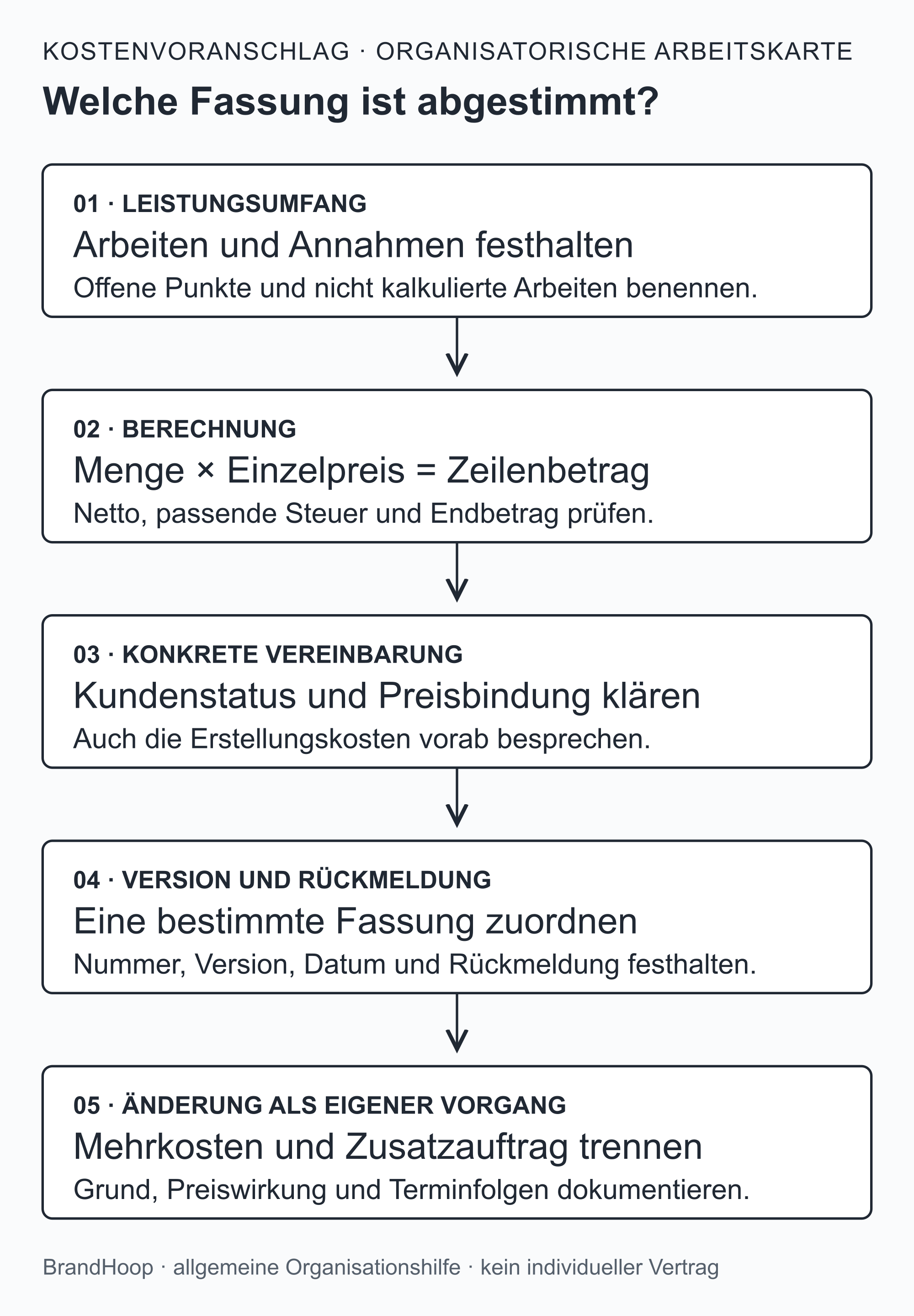
Offer or cost estimate?
A cost estimate can form part of an offer. The terms describe different functions: the calculation explains the costs, while the offer proposes a contract on specific terms. If the customer validly accepts the offer and the parties’ declarations agree, a contract can arise. This follows from § 861 ABGB. [1] [4]
| Term | Purpose | What you cannot infer from it alone |
|---|---|---|
| Offer | Propose a contract with specific work and terms; valid acceptance can lead to a contract | The title alone does not make it a fixed-price offer. |
| Cost estimate | Show the expected cost of each item; can form the basis of an offer and a contract | It is not automatically a non-binding rough estimate. |
| Contract for work | Set out the delivery of a specific result, such as the agreed washbasin replacement | An additional document with this exact heading is not automatically required. |
The WKO guidance on contracts for work explains that the agreed result is at the heart of a contract for work. The general freedom of form under § 883 ABGB explains why the term itself does not require an additional document; statutory requirements as to form still apply. [5] [6]
A rough estimate, by contrast, gives an approximate amount without such a detailed cost breakdown. With a fixed price, you agree a set total for the job described. These distinctions are explained in the WKO overview. When discussing the estimate with the customer, make clear which type of price agreement is intended. [1]
Is the cost estimate binding?
A binding cost estimate includes what is known as a guarantee of accuracy. If it forms the basis of the contract with an express guarantee of its accuracy, you may not demand a price increase for the work included in the estimate, even if it unexpectedly requires more effort or becomes more expensive. This is governed by § 1170a Abs. 1 ABGB. [7]
A non-binding cost estimate does not include this guarantee. But it does not give you a free hand to pass on additional costs. The rules for unavoidable overruns follow below. [7] [2]
Distinguish private customers from businesses
A special starting point applies to consumer transactions: if your cost estimate forms the basis of the contract, its accuracy is deemed guaranteed unless you expressly state otherwise. § 5 Abs. 2 KSchG makes this more than an internal calculation matter. Anyone wishing to keep the estimate non-binding must expressly tell the customer. [3]
Between businesses, often referred to as B2B, a cost estimate is, according to the WKO FAQ non-binding in case of doubt unless otherwise agreed. The actual agreement therefore matters here too. [2]
The customer’s status depends on the specific transaction. Someone who owns a business can still be a consumer when renovating their private bathroom. What matters is whether the job forms part of their business activities. This distinction is set out in § 1 KSchG. [8]
When can you charge for preparing the estimate?
For consumers, the timing of the notice matters. Consumers only have to pay for preparing the estimate if they were told beforehand that they would have to pay. Mentioning this for the first time on the invoice is too late. The basis is § 5 Abs. 1 KSchG. [3]
For business customers, a fee may apply if, for example, detailed calculations or plans are needed, or if the cost estimate constitutes a separate piece of work in its own right. The WKO recommends a clear agreement here too. [2]
In the discussion before preparing the estimate, you can record the preliminary work you will carry out and what it will cost. This includes whether you will credit that amount against a subsequent order. The agreement is then in place when you start the calculation. [b]
Calculate costs in six steps
The line item list starts with the actual job. If the existing connections or the customer’s desired specification are still unclear, those parts of the calculation remain open too. The following six steps help keep these questions visible. [b]
Record the basis: A site visit, plan or recorded measurements provide the starting point. Along with the date, distinguish what has already been checked from what you are assuming for now.
Describe the work: For ‘install washbasin’, make clear whether removal, connection, functional testing and disposal are included. Every task you have costed gets a place in the line item list.
Determine quantities and units: Depending on the work, the appropriate unit may be hours, individual items, m² or linear metres. The material quantity and the area worked on do not have to be the same. The example below shows both values separately.
Calculate prices: Quantity multiplied by unit price gives the line total. Separate items for labour, materials and ancillary costs show how the total is made up.
State dates and limits: A desired start date is not yet a confirmed date. The calculation should therefore also include material availability and specifically named tasks you have not allowed for.
Explain the version and next steps: A version reference shows which draft you are discussing. The customer also needs a clear explanation of how to place the order.
For consumers, final prices must include VAT and any other taxes and surcharges. This is explained by the government consumer portal. Net means excluding VAT; gross means including VAT. Net amounts may also be shown, but the final gross total must remain clear. [9]
Template to copy
You can copy the fields and line item table into your own document. Replace the marked placeholders with the details of the actual job. The template organises the calculation and its underlying conditions; it is neither a complete model contract nor an exhaustive list of legally required information. [b]
Header and project
| Field | Entry |
|---|---|
| Document | Cost estimate no. [Entry]; version [Entry]; date [Entry] |
| Business | Name, address and contact person who can be reached [Entry] |
| Customer and property | Name/company, address, site where the work will take place [Entry] |
| Customer status for this job | Consumer / business: [Entry]; basis for classification [Entry] |
| Project and scope of work | Intended result and specific tasks costed [Entry] |
| Basis of calculation | Site visit/plan/measurements dated [Entry]; open points [Entry] |
| Preparation costs | Free of charge or fee communicated in advance [Entry]; notice/discussion dated [Entry] |
| Timing | Calculation as at [Entry]; discussion planned by [Entry] |
Line items and totals
| Item | Labour or materials | Quantity / unit | Net unit price € | Net amount € | VAT rate |
|---|---|---|---|---|---|
| 1 | [Describe the work specifically] | [Entry] | [Entry] | [Entry] | [Entry] |
| 2 | [Materials with specification/quality] | [Entry] | [Entry] | [Entry] | [Entry] |
| 3 | [Travel, disposal or other ancillary costs] | [Entry] | [Entry] | [Entry] | [Entry] |
Net total: [Entry] €
VAT at the applicable rate: [Entry] €
Final amount including VAT and calculated surcharges: [Entry] €
Net line total = quantity × net unit price. Tax amount = taxable net amount × tax rate. Final amount = net total + tax amount. If several tax rates apply, calculate the total for each rate separately. [c]
The 20% rate in the following example applies under the assumptions stated there. Tax exemptions or other applicable rates require an appropriate presentation. The USP guidance on tax rates and exemptions explains the differences. [10]
Special rules on who owes the tax also affect the presentation. Under the reverse charge system, the recipient business owes the VAT; the invoice is then issued without VAT shown separately. The template’s total fields must reflect the actual tax situation. [11]
Assumptions, dates and discussion
Included: specifically allocated ancillary work, travel and disposal [Entry].
Not costed: specifically named additional tasks [Entry]; outstanding technical assessment [Entry].
Assumptions: condition of existing connections/substrates, accessibility and customer-supplied materials [Entry].
Binding status: binding or expressly non-binding [Entry]; align with the specific agreement.
Dates: desired start [Entry]; confirmed start [Entry]; expected duration and conditions [Entry].
Changes: responsible contact person [Entry]; record the additional order, its costs and its effect on dates separately.
Discussion: version discussed [Entry]; name, date and content of the response [Entry].
Where a signature is used, it should be clear whether it confirms receipt of the document, agreement to specific details or the placing of an order. The order and its terms must suit the specific case. [b]
A list of work excluded from the calculation does not replace a professional assessment or remove statutory duties to provide information and warnings. The WKO explains, for example, the duty to warn where materials are recognisably unsuitable or the customer’s instructions are incorrect. [5]
Example: a limited washbasin job
All details are fictional. Sample no. 2026-MUSTER-01, dated 12 October 2026, customer: a fictional private customer. Subject: replacement of a washbasin and laying 4.00 m² of wall tiles on a prepared substrate outside the shower area. The calculation demonstration assumes a binding cost estimate for precisely this scope. No real business has committed to this price. [a]
For VAT, the example assumes a business subject to standard VAT taxation and a service subject to Austria’s standard VAT rate. The standard rate is 20%. [10]
| Line item | Quantity / unit | Net unit price € | Net amount € |
|---|---|---|---|
| 1. Site protection in the work area | 1 lump sum | 80.00 | 80.00 |
| 2. Removal of existing washbasin | 2 hours | 65.00 | 130.00 |
| 3. Installation, connection and testing of washbasin | 3 hours | 65.00 | 195.00 |
| 4. Laying wall tiles: labour | 4.00 m² | 55.00 | 220.00 |
| 5. Washbasin and tap: materials | 1 set | 420.00 | 420.00 |
| 6. Wall tiles: materials | 4.40 m² | 32.00 | 140.80 |
| 7. Adhesive and grout | 1 set | 48.00 | 48.00 |
| 8. Connection materials | 1 set | 37.00 | 37.00 |
| 9. Travel | 1 lump sum | 45.00 | 45.00 |
| 10. Disposal of removed parts | 1 lump sum | 55.00 | 55.00 |
Totals by cost category
| Cost category | Net € | VAT at 20% € | Gross € |
|---|---|---|---|
| Labour, items 1–4 | 625.00 | 125.00 | 750.00 |
| Materials, items 5–8 | 645.80 | 129.16 | 774.96 |
| Ancillary costs, items 9–10 | 100.00 | 20.00 | 120.00 |
| Total | 1,370.80 | 274.16 | 1,644.96 |
Calculation check: Materials line 6 gives 4.40 × €32.00 = €140.80 net; add €28.16 VAT for a total of €168.96 gross. All ten rows come to €1,370.80 net. €1,370.80 × 20% = €274.16 VAT; the final amount is €1,644.96 gross. [a]
The material quantity of 4.40 m² includes a fictional allowance of 0.40 m² over the 4.00 m² tiled area. This allowance applies only to the example. It does not establish a general rule for wastage.
Scope limits and assumptions in the example
The sample assumes that the existing connections and prepared substrate are suitable. You would need a professional assessment of their actual suitability before carrying out the work. Laying pipework, electrical work, substrate repairs, work affecting waterproofing, moisture damage and work on the shower or bath are excluded from the calculation. For a real job, you would need to describe the material specification and measurements precisely.
You would need to agree the start and duration after checking the conditions and delivery availability. In the sample, there is no charge for preparing the cost estimate. The total relates to the fictional line item list. It is not a cost estimate for a complete bathroom renovation.
Additional costs and extra work
With a cost estimate that carries no guarantee of accuracy, an unavoidable, substantial overrun may become apparent during the work. Once this is certain, you must inform the customer immediately. They may then withdraw from the contract, but must pay reasonable compensation for work already completed. If you fail to notify them, you lose your claim for payment for the additional work. This is governed by § 1170a Abs. 2 ABGB. [7]
This does not imply a generally permitted percentage increase. Whether the overrun is substantial depends on the individual case; even a non-binding cost estimate requires careful calculation. When notifying the customer, it is advisable to explain the reason and the expected additional costs specifically, insofar as they can already be estimated. For the project, this also includes the effect on the schedule. [1]
Additional customer requests are a separate matter. If the customer orders different or further work, record its scope and costs separately. The WKO recommends obtaining written consent to the specific additional costs before carrying out the work. This also applies if the existing cost estimate was binding. [1] [2]
An addendum supplements the existing cost estimate. As a working document, it links the change to the relevant number and version. The following details are useful: [b]
Reference to the cost estimate number and version.
The change, its reason and the affected line items.
Which tasks are being added or removed and how the costs change.
Effect on dates and an updated cost breakdown.
The customer’s response, with the date.
The general statement ‘additional costs possible’ does not provide this information. If the actual costs are lower, billing depends on the agreed method of charging. A cost estimate and a fixed price are different agreements in this respect too. [1] [5]
Checklist before sending
Before sending, it is worth reading the document once more from the customer’s perspective. The details should make the costed job understandable and match the agreement you discussed. [b]
Are the project, customer, property and version correct?
Are the tasks, materials, quantities and units understandable?
Are travel, disposal and other surcharges clearly allocated?
Are the rows, tax rate, net total and final gross amount correct?
Do the customer’s status and preparation costs match the agreement? Have you also stated the binding status as agreed?
Does the customer understand the assumptions, open technical questions, dates and next steps?
The version actually sent and the responses to it belong with the project records. When billing later, you can then check which version you discussed with the customer. The template takes its substance from the work you have actually costed for this job.
Further reading
- Create a job order form: record the agreed work for the team.
- Create a project status report: record the current state of a job.
- Write a payment reminder: check the invoice and payment, then send a factual reminder.
Sources and use
The legal basis and tax information were checked against Austrian primary sources on 16 October 2026. The two WKO pages on cost estimates state that their information is current as at 15 October 2025. An update date in the RIS must be distinguished from the date on which a provision enters into force. [1] [2] [7]
The article, worked example and structural template provide general guidance. The template supports discussion of your calculation. It does not contain a contract for a particular case and does not automatically suit every legal situation.
Editorial version dated 16 October 2026. Numbers link to sources; letters explain editorial examples or recommendations. Each source note states what the source supports.
[a] Editorial examples. Content labelled as a sample or fictional illustrates possible situations. It does not describe real customer cases or provide evidence of a measured effect.
[b] Practical recommendations. The suggested processes and decision aids are editorial applications of the sources cited. Their specific effect on enquiries or orders has not been measured here.
[c] Editorial illustration. The illustration explains a relationship. It is neither a real customer reference nor evidence of a measured effect.
Sources and context (11 sources)
- Kostenvoranschlag – Allgemeiner Überblick — Wirtschaftskammer Österreich
Explains the cost breakdown, offers, rough estimates and fixed prices, as well as how to handle cost overruns and additional work. The percentage mentioned is not a generally permitted surcharge. Does not substantiate market prices or the template’s effectiveness. The passage on lower actual costs differs from the page on contracts for work; no general billing rule is taken from it. Checked: 2026-10-16.
- Kostenvoranschlag – FAQs — Wirtschaftskammer Österreich
Supports the distinction between consumers and B2B transactions, advance notice of preparation costs and the recommendation to obtain written consent to additional costs. The recommendation is not presented as a general statutory requirement for written form. No fixed fee or generally permitted percentage for additional costs is inferred. Checked: 2026-10-16.
- RIS: § 5 KSchG – Kostenvoranschläge — Rechtsinformationssystem des Bundes
Supports the requirement to inform consumers in advance of their obligation to pay for preparation, and the guarantee of accuracy for an estimate used as the basis of a contract unless the contrary is expressly stated. Makes no statement about specific fees or automatic crediting of the preparation charge when an order is placed. Checked: 2026-10-16.
- RIS: § 861 ABGB – Abschluss des Vertrags — Rechtsinformationssystem des Bundes
Supports the formation of a contract through valid acceptance and agreement of the parties’ intentions. This does not mean that every response or signature constitutes an order. Checked: 2026-10-16.
- Werkverträge – Warnpflicht des Werkunternehmers — Wirtschaftskammer Österreich
Supports the requirement for a specific result as the subject of a contract for work, as well as duties to inspect and warn where materials are recognisably unsuitable or instructions are incorrect. Does not provide technical approval for the fictional washbasin work. The differing statement about who benefits when less work is required is not used as a universal billing rule. Checked: 2026-10-16.
- RIS: § 883 ABGB – Form der Verträge — Rechtsinformationssystem des Bundes
Supports the general freedom of form, subject to statutory exceptions. The statement about an additional document is a limited application of this principle, not a promise that every job is free of all formal requirements. The ELI address returned a 503 error; the NormDokument page cited here was read. Checked: 2026-10-16.
- RIS: § 1170a ABGB – Kostenvoranschlag — Rechtsinformationssystem des Bundes
Paragraph 1 concerns an estimate used as the basis of a contract with an express guarantee of accuracy. Paragraph 2 governs unavoidable substantial overruns without a guarantee, immediate notification, withdrawal and loss of the claim for additional work if notification is omitted. No statutory percentage threshold is stated, and no additional work requested by the customer is read into the guaranteed scope. Checked: 2026-10-16.
- RIS: § 1 KSchG – Geltungsbereich — Rechtsinformationssystem des Bundes
Supports classification according to whether the specific transaction forms part of a business’s activities. The private bathroom is an explanatory example, not a finding about a real person’s status. The original URL for the consolidated text was retained in the article but returned a 503 error when accessed; this direct page for the provision was read instead. Checked: 2026-10-16.
- Konsumentenfragen: Kostenvoranschlag — Sozialministerium, government consumer portal
Confirms that final gross prices for consumers include VAT and any other taxes and surcharges. The simplified percentages given there are not adopted as generally permitted cost overruns. Guidance on additional orders and possible crediting of preparation costs is not a promise for every contract. Checked: 2026-10-16.
- Steuersätze und Steuerbefreiungen der Umsatzsteuer — Unternehmensserviceportal; content provided by the Bundesministerium für Finanzen
Confirms 20% as Austria’s standard VAT rate and the existence of other rates and exemptions. The classification of a real job is not assessed; the sample calculation expressly assumes a case to which standard VAT taxation applies. Does not substantiate market prices, a rounding rule or individual tax advice. Checked: 2026-10-16.
- Reverse Charge System — Unternehmensserviceportal; content provided by the Bundesministerium für Finanzen
Explains the transfer of VAT liability to the recipient business and invoicing without VAT shown separately in a reverse charge case. The article gives this as a conditional exception; it does not determine that any particular trades job falls within it. Invoice requirements are not presented as a complete list of mandatory information for a cost estimate. Checked: 2026-10-16.